


At a glance:
- Audited on: relevanssi.com feature and pricing pages; WordPress.org listing (version 4.28.3, last updated September 2026, tested up to WordPress 7.1); the knowledge base documentation (200+ articles); the pricing page. Pricing verified at relevanssi.com on September 10, 2026.
- Free tier: relevance-based result ranking, partial word/fuzzy matching, AND/OR/phrase query operators, custom excerpts with highlighted search terms, comment and author searching, tag/category/custom taxonomy searching, custom field indexing, shortcode content indexing, WPML and Polylang support, bbPress compatibility, query logging including recent queries with no hits, synonym management, stopword management, developer filter hooks.
- Paid tiers: Premium at EUR 120/year (unlimited sites) or EUR 402 one-time permanent (unlimited sites). Premium adds: PDF and document indexing, user profile search, taxonomy term page results, NOT operator, post-type and taxonomy weighting, date-based relevance weighting, multisite network searching, WP CLI commands, related posts functionality, and settings import/export.
- Bottom line: the most capable free WordPress search replacement available. The free version solves the problems that frustrate most WordPress site owners: exact-word-only matching, no partial-word searching, no custom field indexing, and no contextual excerpts. Premium extends this to document indexing, multisite, and user profiles at a flat rate covering unlimited sites.
Quick verdict
WordPress’s default search disappoints most site owners. Its exact-word-only matching misses partial words and synonyms. It cannot search custom fields by default. It generates excerpts from the beginning of post content rather than from where search terms appear. And its basic relevance algorithm uses publication date as a tiebreaker, which for many single-term queries produces results that feel effectively date-ordered. Relevanssi corrects all of this for free, with no external service, no API key, and no ongoing subscription required.
The free version is the right answer for the majority of WordPress sites: blogs, portfolios, documentation sites, small business sites, and any WordPress project where site search is expected to actually find things. Installation takes five minutes. The index builds automatically. Search quality improves immediately.
The Premium version at EUR 120/year or EUR 402 one-time is worth the investment for specific use cases: sites that need PDF or document content indexed, multisite networks that require cross-site searching, membership or directory sites where user profiles should appear in results, and sites that need post-type-specific relevance weighting. Because both Premium plans cover unlimited sites, agencies building multiple client sites get a straightforward per-project deal.
Quick verdict card:
- Best for: WordPress sites where default search returns poor results (blogs, documentation sites, knowledge bases, directories, WooCommerce stores, membership sites, multisite networks).
- Best plan for most sites: Relevanssi free. The free version covers every essential search improvement including relevance ranking, fuzzy matching, phrase queries, synonym control, custom field indexing, and query logging with zero-results tracking. Most WordPress sites do not need more.
- Best plan for agencies and multi-site operators: Premium Permanent at EUR 402 one-time. Unlimited sites, no annual renewal, full feature set including multisite search, document indexing, and user profiles.
- Standout: genuine TF-IDF relevance ranking with configurable weights; fuzzy/partial-word matching included free; synonyms and stopwords with full admin control; query logging with zero-results tracking free; over 200 knowledge base articles; developer-friendly hook system; 10+ years of active maintenance; 4.8/5 from 405 reviews.
- Watch out for: increased database size (roughly three times the content table footprint); performance limitations on very large sites (200,000+ posts); no money-back guarantee stated; live/autocomplete search requires a separate companion plugin; premium pricing in euros, not USD.
What Relevanssi is
Relevanssi is a WordPress plugin that replaces the built-in search engine entirely. WordPress core applies a basic relevance algorithm: it matches exact words only, cannot search custom fields or taxonomy content by default, and uses publication date as a tiebreaker when multiple posts have equal relevance scores. For many practical queries, especially single-term searches where matching posts have similar score values, this produces results that feel effectively date-ordered. A search for “booking system” on a site with a post titled “appointment scheduling system” returns nothing, because the default engine requires exact matches and does not connect related terms.
Relevanssi replaces this with a proper TF-IDF relevance scoring engine. It scores each matching document against the query using term frequency (how often the word appears), inverse document frequency (how rare the word is across all indexed content), term positioning (whether the word appears in the title vs the body), and configurable field weights. It also introduces partial word matching, phrase queries, synonym expansion, and custom field indexing: capabilities that are entirely absent from WordPress core search. The improvement in result quality is significant, particularly for sites with structured content, custom post types, or detailed product descriptions.
The plugin has been actively developed since 2010. Mikko Saari, a Finnish developer with a background in information retrieval, built Relevanssi as a project grounded in information retrieval principles and has maintained it as a commercial plugin ever since. In recent years, comesio solutions took on the stewarding role, providing commercial infrastructure and support while Saari remained as lead developer. That combination of academic rigor and commercial maintenance is unusual in the WordPress plugin market and helps explain why the documentation is among the most thorough of any plugin in any category.
The current release, version 4.28.3, is tested up to WordPress 7.1 and has accumulated 100,000+ active installs and 405 reviews on WordPress.org, with 369 of those rated five stars. That 91% five-star rate is exceptional for any plugin, and the substance of the reviews is consistent: the plugin works well, support is fast, and the documentation answers most questions before they need to be asked.
Who Relevanssi is best for
Strong fit:
- WordPress blogs and content sites where visitors use search to find articles. Relevanssi’s partial word matching and TF-IDF relevance ranking turn site search from an afterthought into a functional discovery tool.
- Documentation sites and knowledge bases where users search by concept rather than exact keyword. Fuzzy matching and synonym support handle the vocabulary gap between how users describe problems and how documentation titles them.
- WooCommerce stores with moderate product catalogs (under 50,000 products). Relevanssi indexes product custom fields, product categories, and product attributes, giving shoppers more useful search results than WooCommerce’s default search.
- Membership and directory sites that index user-generated content. Relevanssi’s comment searching ensures user discussion appears in results. Premium adds user profile searching, which is essential for directory sites where members search for other members.
- Multilingual WordPress sites using WPML or Polylang. Relevanssi has explicit compatibility with both and respects language-filtered search results.
- Developers building custom WordPress applications. Relevanssi provides over 100 documented filter hooks, making it one of the most customizable search solutions for WordPress. Every aspect of the relevance score, index content, and result presentation can be modified without forking the plugin.
- Multisite network operators (Premium). The ability to search across multiple subsites from a single query serves a real need that the default WordPress multisite search does not address.
- Sites hosting PDF or document libraries (Premium). Relevanssi Premium indexes the text content of PDFs and Office-format documents, making attached files discoverable through site search.
Weak fit:
- Very large sites with 200,000+ posts. Multiple user reviews report performance degradation at extreme scale. At that volume, enterprise solutions like ElasticPress with an Elasticsearch backend are better suited.
- Sites on resource-constrained shared hosting. Relevanssi maintains its own search index as a database table, which can grow to roughly three times the size of the content it indexes. Relevanssi Light (a separate, stripped-down plugin) exists for this scenario.
- Sites that need real-time live autocomplete search out of the box. Live Ajax search (autocomplete as a user types) requires the separate “Relevanssi Live Ajax Search” companion plugin.
- Stores that need advanced WooCommerce search (product filtering, attribute-based search, visual autocomplete with thumbnails) as a turnkey solution. Dedicated WooCommerce search plugins like FiboSearch are more complete out of the box for that specific use case.
- Sites that need a fully managed external search service with zero server-side overhead. Sites that need Elasticsearch or Algolia infrastructure should look at ElasticPress or SearchWP with external index support.
Setting up Relevanssi
Relevanssi installs from the WordPress plugin directory in the standard way. From the WordPress admin, navigate to Plugins, Add New, search for “Relevanssi,” and install the plugin by Mikko Saari. Activation is one click.
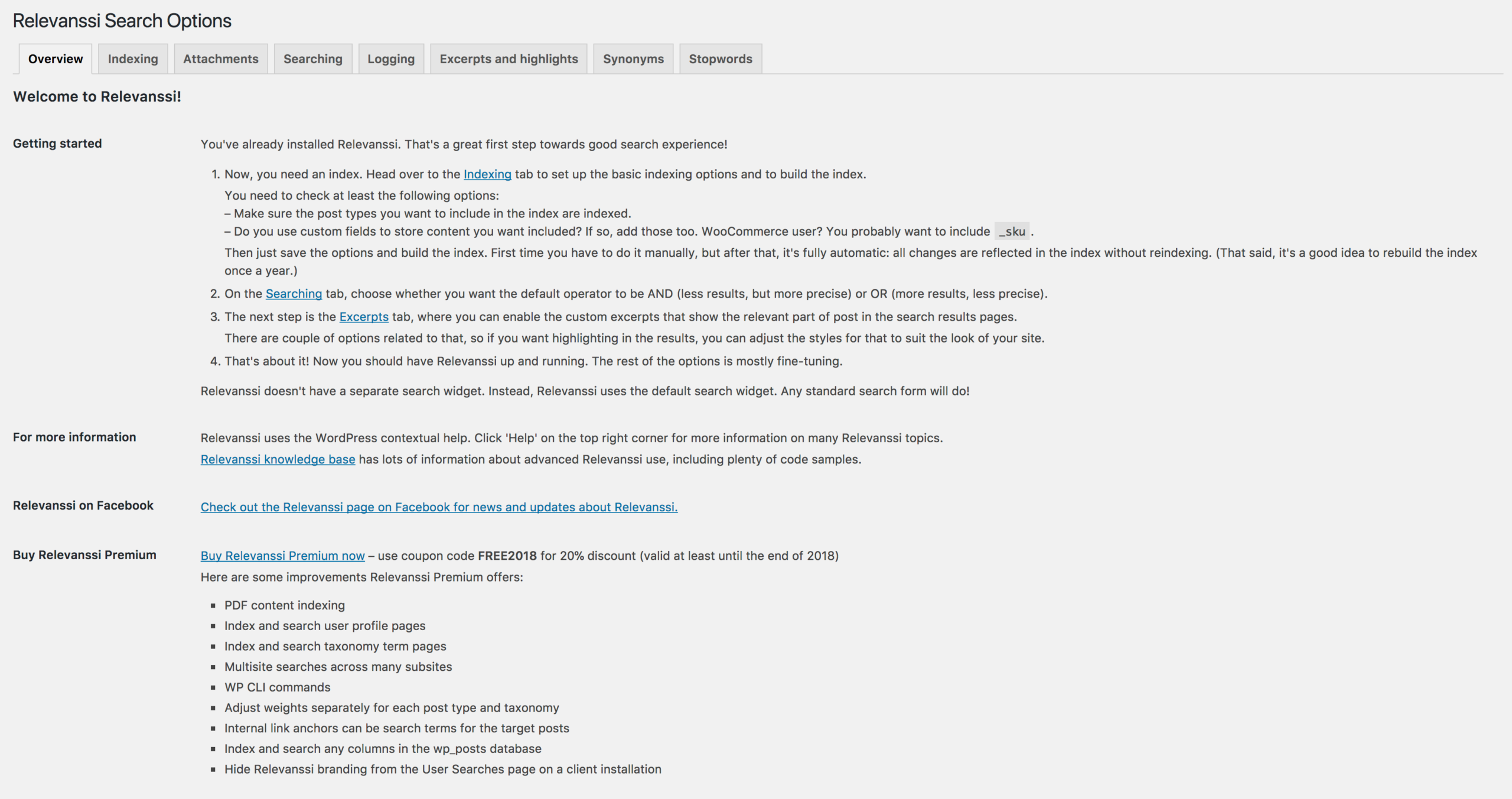
After activation, Relevanssi adds a settings panel in the WordPress admin under Relevanssi. The first required step is building the search index. The indexing screen shows a “Build index” button with a progress bar. On a typical blog with a few hundred posts, indexing completes in under a minute. The plugin indexes not just post content but also custom fields, tags, categories, and comments based on the settings you configure.
No external account is needed. No API key is required. No external service connection is made. Relevanssi is entirely self-contained.
The settings panel covers four main areas:
- Indexing settings. Choose which post types, taxonomies, and custom fields to index. Toggle whether to include comments, post excerpts, author names, and shortcode-generated content. This is where you expand or restrict what appears in search results.
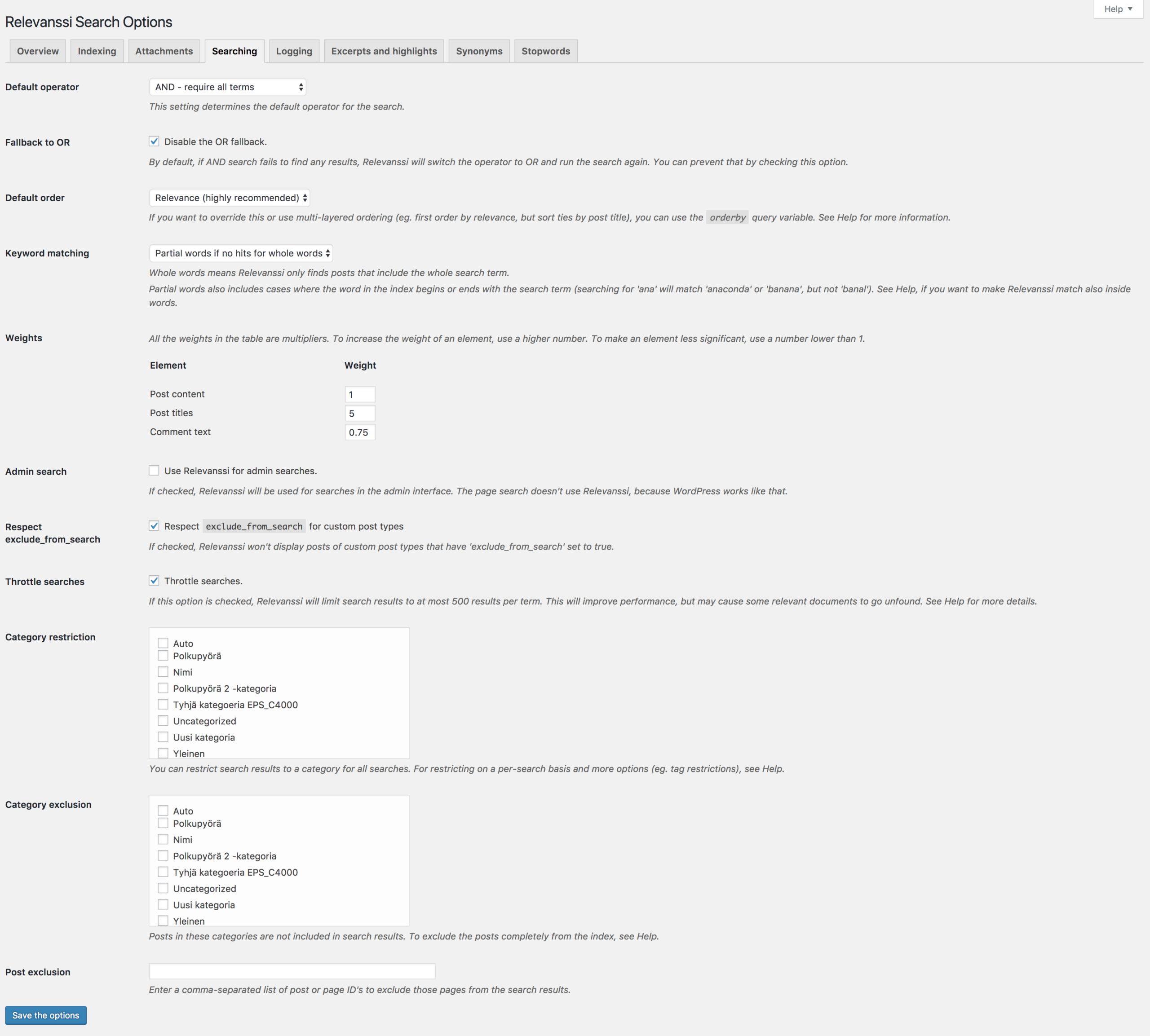
- Searching settings. Set the default query operator (AND or OR), configure how partial word matching works, enable phrase searching, set relevance score weights for different content types (title matches worth more than body matches, for example), and configure result ordering.
- Logging settings. Enable query logging to track what visitors search for, view popular search terms, and identify recent searches that returned no results. This is a practical SEO input that reveals content gaps.
- Stopwords and synonyms. Define words to ignore (common words that inflate the index without improving results), and set synonym pairs so a search for “booking” also finds “appointment” and “reservation.”
The plugin updates the index automatically when posts are published, updated, or deleted, so the index stays current without manual rebuilding.
Relevance ranking and result quality
The core improvement Relevanssi makes over WordPress default search is in how results are ranked. WordPress core has applied a basic relevance score to multi-term queries since version 3.7, but this algorithm has important limitations: it works with exact word matches only, uses publication date as the tiebreaker for results with equal relevance scores, and for single-term queries often returns results in a sequence that closely follows post date. A comprehensive five-year-old guide that uses your search words with the same frequency as a recent brief mention will not reliably outrank that newer post in default WordPress search.
Relevanssi replaces this with TF-IDF scoring (term frequency multiplied by inverse document frequency), which is the standard weighting scheme used in information retrieval research. A word that appears frequently in one document but rarely across the site scores higher than a word that appears in nearly every document. This means a post specifically focused on the search topic outranks one that merely mentions the topic in passing, regardless of publication date.
On top of TF-IDF, Relevanssi adds field-based weighting. By default, a keyword match in the post title scores higher than a match in the body, which scores higher than a match in a comment or custom field. These weights are adjustable in the settings panel. You can set title matches to be worth ten times body matches, or equalize all fields, depending on your content structure.
Partial word matching is enabled by default. A search for “book” returns results for “booking,” “bookings,” “booked,” and “ebook” without any configuration. WordPress default search requires exact word matches and will miss all of these. For e-commerce sites and documentation sites especially, partial matching dramatically increases the number of searches that return useful results.
Phrase searching is supported with double quotes. A visitor who searches for “appointment booking” in quotes receives only results where those two words appear adjacent, giving them a way to narrow a broad search when needed.
Custom excerpts with highlighted terms
WordPress’s default search page returns the post excerpt or the first 55 words of content regardless of where the searched term appears in the post. A visitor searching for a specific topic often sees an excerpt from the introduction, which may not mention the term at all, with no way to tell whether the result is actually relevant.
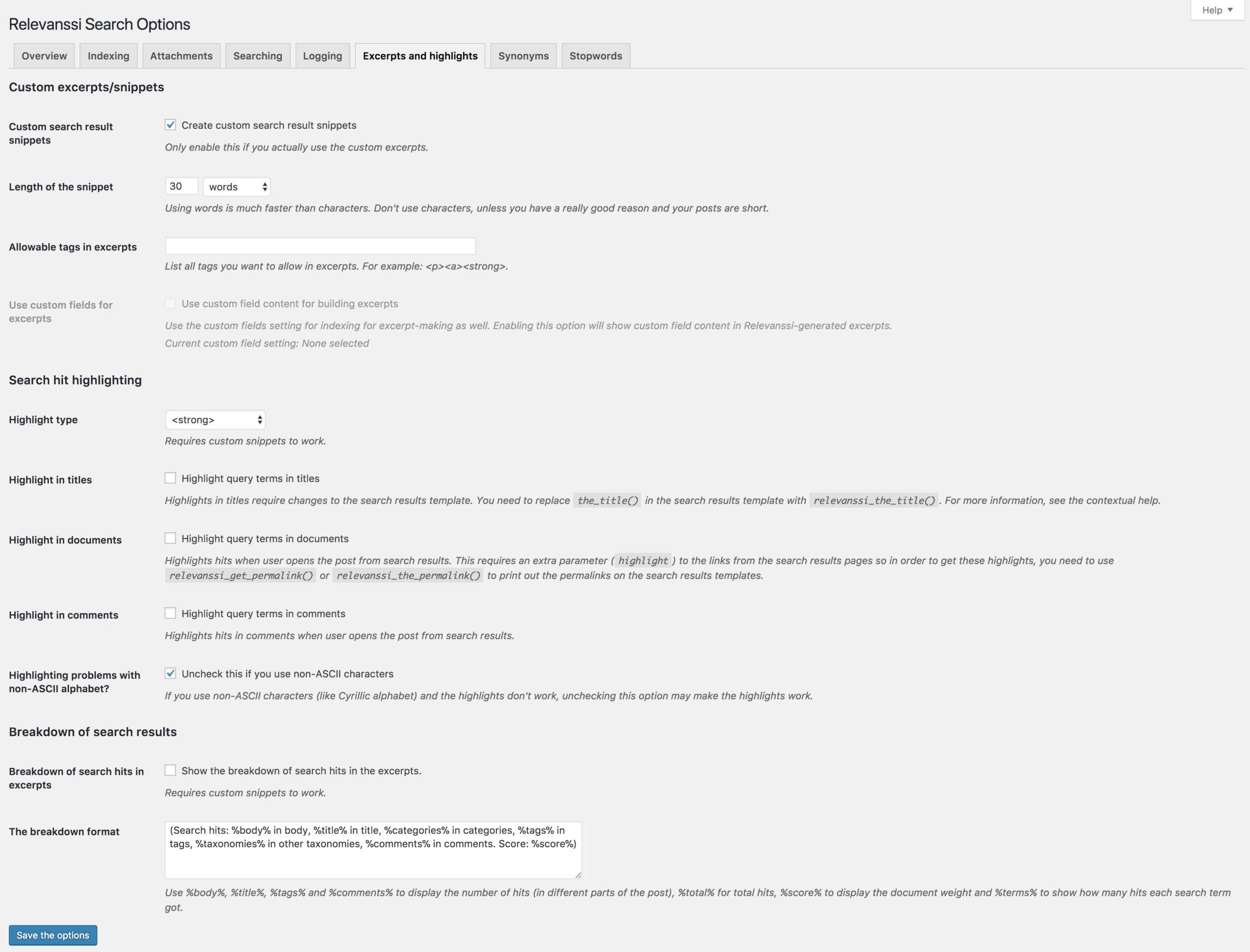
Relevanssi replaces excerpts with custom-generated snippets that surround the matched search terms with context. The excerpt shows text from the part of the document where the search terms actually appear, and the matched terms are highlighted. This gives visitors confirmation that the result is relevant before they click.
The excerpt length and highlight styling are configurable. Developers can adjust both through the settings panel or via filter hooks for more precise control. The highlighting uses configurable HTML tags, so the visual style integrates with the site theme without custom CSS overrides.
Synonym and stopword management
Two features that separate a search plugin from a basic search improvement are synonym management and stopword control.
Synonyms let you define word relationships for the search engine. If your site covers appointment scheduling software, a visitor searching for “reservation system” would miss all posts about “booking system” under WordPress default search. With Relevanssi’s synonym settings, you define “reservation = booking” and both searches return the same result set. This vocabulary bridging is especially valuable for technical sites where the same concept goes by multiple names, and for WooCommerce stores where customers use different words than product descriptions.
Stopwords let you exclude common words from the index. Words like “the,” “a,” “and,” and “or” appear in nearly every post and add database weight without improving search accuracy. Relevanssi ships with a default stopword list and lets you expand it in the settings panel. For specialized sites, you can add domain-specific words that are ubiquitous enough to be meaningless in a search context.
The synonym and stopword settings are accessible in the WordPress admin without code changes. Developers who need more complex synonym patterns (one-to-many, language-specific, or programmatic) can use filter hooks to inject synonyms at query time.
Query logging and search analytics
Relevanssi includes query logging in the free version. When logging is enabled, every search on the site is recorded with the query string, the number of results returned, and a timestamp. The Relevanssi admin panel shows the most popular queries and, importantly, recent queries with no hits: searches that returned zero results. This zero-results report is included free and is one of the most practically useful features in the plugin; it surfaces content gaps directly from real visitor behavior rather than from keyword tool estimates.
The logging data answers practical content strategy questions: what are visitors looking for, which searches turn up empty, and how search behavior changes over time. For sites investing in SEO or content marketing, this is a direct signal from real users with no additional tool required.
Live Ajax search (companion plugin)
Relevanssi itself handles the traditional search results page: the visitor types a query, submits the form, and sees a results page with ranked posts. It does not, by default, provide live autocomplete search (where results appear as the visitor types before submitting the form).
Live autocomplete search requires the separate “Relevanssi Live Ajax Search” plugin, also available free on WordPress.org. This companion plugin adds the live search dropdown behavior and pulls results from the Relevanssi index, so it benefits from all the relevance ranking and custom field indexing that the main plugin provides.
This two-plugin architecture is worth understanding before installing. If your goal is to replace the standard search form with a live-search dropdown, you need both plugins. If your goal is to improve the existing search results page (which most sites need more urgently anyway), Relevanssi alone is sufficient.
Premium-exclusive features
Relevanssi Premium adds capabilities that go beyond improving search result quality for standard post content.
PDF and document indexing. Premium indexes the text content of attachments: PDFs, Word documents (DOC), OpenDocument files (ODT), RTF files, and ePub files. If a site hosts a library of PDF guides, product manuals, or policy documents, Premium makes their content searchable alongside regular posts.
User profile searching. Premium includes user profiles in search results. When a visitor searches for a name or phrase that appears in a user’s profile, that user appears in the results. This is essential for directory sites, membership communities, and any WordPress installation where finding specific people is a use case.
Taxonomy term page results. Standard Relevanssi returns posts. Premium can return taxonomy term archive pages: the category or tag page for a term that matches the search query. This is useful when the archive page itself (with its aggregated content) is more useful to the visitor than any individual post.
NOT operator. Premium adds a NOT operator for search queries. A search for “booking -hotel” returns results about booking that exclude anything about hotels. This gives advanced users a way to narrow searches without needing site-specific filtering UI.
Post-type and taxonomy weighting. Premium adds the ability to set different relevance weights per post type and per taxonomy. If a site has both posts and documentation, you can configure documentation to rank higher than posts when both match a query. This is valuable on complex sites where content types have different audience intent.
Multisite search. Premium supports searching across the entire WordPress multisite network from a single search query. Content from all subsites appears in a unified result set, with each result attributed to its source subsite. This capability has no free equivalent in WordPress core.
Related posts. Premium includes a related posts feature that uses the search index to surface content related to the current post. Unlike simple tag-based related posts, Relevanssi’s related posts calculation uses the same relevance scoring as search, which tends to surface more contextually relevant content.
WooCommerce compatibility
Relevanssi is compatible with WooCommerce out of the box and indexes product content including product titles, descriptions, custom fields, and product taxonomy terms (categories, tags, and attributes). WooCommerce product variations and SKU data can be indexed through custom field settings.
The improvement over WooCommerce’s default search is significant for stores with detailed product descriptions. WooCommerce default search relies on the same basic WordPress algorithm: exact-word matching only, no contextual excerpt highlighting, and a basic relevance score that uses date ordering as a fallback for equal-relevance results. Relevanssi turns the product search page into a TF-IDF relevance-ranked, highlighted-excerpt result set.
For stores that need dedicated WooCommerce search with visual autocomplete, product thumbnail display in the dropdown, and attribute-based filtering, dedicated plugins like FiboSearch serve that use case more completely. But for stores where the primary problem is search results being irrelevant or missing, Relevanssi is a practical no-cost improvement.
Pricing and license value
Relevanssi is available free on WordPress.org with no post-count limits and no time restriction. The Premium version is available at relevanssi.com in two licensing models. All pricing is in euros. Pricing verified September 10, 2026.
Annual License: EUR 120/year. Covers unlimited site installations. Includes priority support and updates for 12 months. Renewal extends support and updates for another year; the plugin continues to function after expiry but no longer receives new features or security updates without renewal.
Permanent License: EUR 402 (one-time payment). Covers unlimited site installations. Lifetime access to updates and priority support for the current major version. No annual renewal required.
What both plans include: all Premium features (PDF and document indexing, user profile search, taxonomy term results, NOT operator, post-type and taxonomy weighting, multisite search, WP CLI commands, related posts, settings import/export), unlimited site licenses, priority support, and plugin updates for the license period.
No money-back guarantee is stated on the purchase page. Confirm the refund policy directly with the team before purchasing if a return option matters to your decision.
How the pricing compares:
- Against SearchWP: SearchWP Standard is $99/year for one site, Pro is $199/year for unlimited sites. Relevanssi Premium at EUR 120/year (approximately USD 130) covers unlimited sites, making it more cost-effective than SearchWP for agencies with multiple sites.
- Against Ivory Search (free): Ivory Search adds some basic search improvements including live Ajax search and filtering, but lacks Relevanssi’s TF-IDF relevance scoring depth, synonym support, and premium indexing features. Relevanssi free already outperforms Ivory Search for serious search quality needs.
- For most single sites: Relevanssi free is the correct answer and involves no purchase at all.
Pros and cons
Pros
- Most capable free WordPress search replacement in the ecosystem. TF-IDF relevance ranking, partial word matching, phrase search, synonym management, custom field indexing, and query logging with zero-results tracking, all at no cost.
- Both Premium plans cover unlimited sites. EUR 120/year or EUR 402 one-time for any number of WordPress installations is strong value for agencies and multi-site operators.
- 10+ years of active, continuous development. The plugin has been maintained through every major WordPress version change.
- 4.8/5 from 405 WordPress.org reviews. 91% of reviewers rated it five stars.
- Over 200 knowledge base articles. Documentation depth exceeds most commercial WordPress plugins.
- Developer-friendly architecture. 100+ filter hooks let developers customize every aspect of indexing, scoring, and result presentation.
- WPML and Polylang support with language-filtered search results.
- PDF and document indexing in Premium makes attached files searchable alongside regular posts.
- comesio solutions backing plus Mikko Saari as lead developer provides stable long-term maintenance.
Cons
- Increased database size. The search index can grow to roughly three times the size of the post content. On large sites or hosts with tight database quotas, this is a real constraint.
- Performance ceiling at very large scale. Sites with 200,000+ posts report degraded performance. ElasticPress with Elasticsearch is better for enterprise-scale WordPress.
- No money-back guarantee stated. Unlike most SaaS-style plugin vendors with 14 or 30-day refund windows, Relevanssi’s purchase page does not state a refund policy.
- Live search requires a second plugin. Relevanssi handles search results pages; live autocomplete requires the separate Relevanssi Live Ajax Search companion plugin.
- Premium pricing in euros. For buyers outside the Eurozone, the effective cost fluctuates with exchange rates.
- No visual WooCommerce search autocomplete out of the box. Stores needing autocomplete dropdowns with product thumbnails need additional configuration or a dedicated WooCommerce search plugin.
- Premium requires WordPress 6.9+ and PHP 7.2+. Legacy installations must upgrade before using Premium.
- No free trial for Premium. The free version is the test drive; there is no time-limited access to Premium features before purchase.
Alternatives to Relevanssi
SearchWP. The most direct paid competitor. SearchWP is a premium-only WordPress search replacement with a strong extension marketplace, including dedicated WooCommerce search extensions, live search, and WooCommerce attribute filtering. SearchWP Standard is $99/year for one site; Pro is $199/year for unlimited sites. SearchWP requires a paid license for any use, while Relevanssi’s free tier already covers most of what SearchWP Standard provides. SearchWP’s extension ecosystem gives it an edge for stores with complex WooCommerce search needs.
Ivory Search. A free WordPress plugin that adds live Ajax search, search form customization, and some result filtering improvements. Simpler to configure than Relevanssi and includes live search without a companion plugin. Ivory Search does not match Relevanssi on relevance scoring depth, synonym management, or developer customizability. For sites that just need a search form style refresh or basic live search, Ivory Search is a lower-overhead option.
FiboSearch (Ajax Search for WooCommerce). A dedicated WooCommerce search plugin with visual autocomplete, product thumbnail display, attribute filtering, and analytics. Free and paid tiers available. FiboSearch solves WooCommerce-specific search UX problems that Relevanssi does not address by design. For stores where the priority is visual search autocomplete with product images, FiboSearch is more directly focused on that outcome.
ElasticPress. A WordPress plugin that connects WordPress search to Elasticsearch, either self-hosted or via ElasticPress.io managed hosting. ElasticPress offers enterprise-scale performance with millisecond search response times regardless of content volume, faceted filtering, real-time index updates, and WooCommerce integration. The correct choice for very large WordPress sites (100,000+ posts) where Relevanssi’s performance ceiling becomes a constraint. The cost and infrastructure overhead is significantly higher than any locally-indexed plugin.
WP Extended Search. A lightweight free plugin that adds some basic improvements to WordPress search: post type filtering, search by custom field, and exclude certain post types from results. Much simpler than Relevanssi and lacks TF-IDF relevance ranking, fuzzy matching, or synonym support. For sites that just need to add a post type filter to the search form, WP Extended Search has a simpler footprint.
Final verdict
Relevanssi earns its standing as the most-installed free WordPress search replacement. The case for it is straightforward: WordPress core search applies exact-word matching, cannot search custom fields or attachments, and uses a basic relevance algorithm that frequently defaults to date ordering for common queries. That is not what visitors expect when they type a query into a search box.
Relevanssi addresses all of these gaps directly. It brings TF-IDF relevance scoring, partial word matching, phrase queries, synonym expansion, custom field indexing, and contextual excerpt generation with highlighted terms. It does this for free, without external dependencies, and with enough filter hooks to support serious developer customization.
The free version covers the needs of most WordPress sites completely. There is no artificial feature cap designed to force an upgrade. Blogs, documentation sites, small business sites, and most WooCommerce stores with under 50,000 products will find that the free version is all they need. The inclusion of zero-results query logging in the free tier is particularly useful: it hands site owners a direct signal for content planning with no additional paid tool required.
Premium is worth purchasing for four specific scenarios: sites with PDF and document libraries, multisite networks that need unified search, directory or membership sites where user profiles should appear in results, and agencies that need Premium features across multiple client sites (the unlimited-site licensing makes this straightforward).
The one friction point worth stating plainly is the absence of a stated money-back guarantee. Other plugin vendors in this category have removed purchase risk entirely with 30-day return windows. Relevanssi has not, at least not in the public pricing copy. For buyers who want certainty before committing, the free version is a genuine working test of the plugin’s core architecture. The query logging, relevance ranking, synonym settings, and partial-word matching all work in the free tier; upgrading to Premium adds depth rather than changing the fundamental behavior.
After more than a decade of development and 100,000 active installs, Relevanssi is the established answer to the WordPress search problem, and for most sites, the free version is the complete answer.