

Breakdance is not a name you see on every WordPress forum thread. Elementor has 10 million active installs. Breakdance has around 100,000 users. But the builders behind it shipped Oxygen, one of the most respected performance-first page builders among developers, and they followed it with something designed for a wider audience.
I spent time working through Breakdance 3.0 on a clean WordPress sandbox, tested the editor, forms, WooCommerce tools, and the new AI building features, and cross-checked pricing, performance claims, and real user reports. The version numbers mean something here: Breakdance 3.0 was released in July 2026 and includes MCP-based AI site building, a rebuilt Selectors system, and CSS Variables. It is a significant update, and it changes how you should evaluate the product.
This review covers the full picture, free tier included.
Quick Verdict
Breakdance is a strong mid-market WordPress page builder for freelancers and agencies who want performance, built-in WooCommerce tools, and a complete feature set without buying a collection of add-on plugins. It is significantly faster than Elementor out of the box, cheaper for unlimited-site use, and it ships with a form builder, popup builder, and WooCommerce customization engine that would each cost extra with Elementor.
- Best for: freelancers, agencies, and small-to-medium businesses who want a fast, feature-complete site builder without plugin sprawl.
- Best free use case: prototyping, small sites, or testing the editor before committing to a Pro license.
- Best paid use case: agency workflows building multiple WordPress sites, WooCommerce projects, and any project where Core Web Vitals are part of the brief.
- Standout: 42 KB baseline asset size versus Elementor’s 570 KB, no jQuery dependency, and a 60-day money-back guarantee.
- Watch out for: a thin third-party ecosystem compared to Elementor, a learning curve if you are coming from a different builder, and the historical controversy around Soflyy’s deprecation of Oxygen (important context for long-term commitment decisions).
What Breakdance Is
Breakdance is a WordPress page builder made by Soflyy, the company behind WP All Import and the now-discontinued Oxygen Builder. It launched in 2023 as a successor designed for a broader audience than Oxygen’s developer-first positioning.
The plugin works as a full site builder. You use it to design individual pages, but also headers, footers, archive templates, 404 pages, and blog post templates, all in the same visual editor. It replaces your WordPress theme’s output entirely if you use its Zero Theme or Themeless Mode options, which removes theme overhead and gives you a blank canvas.
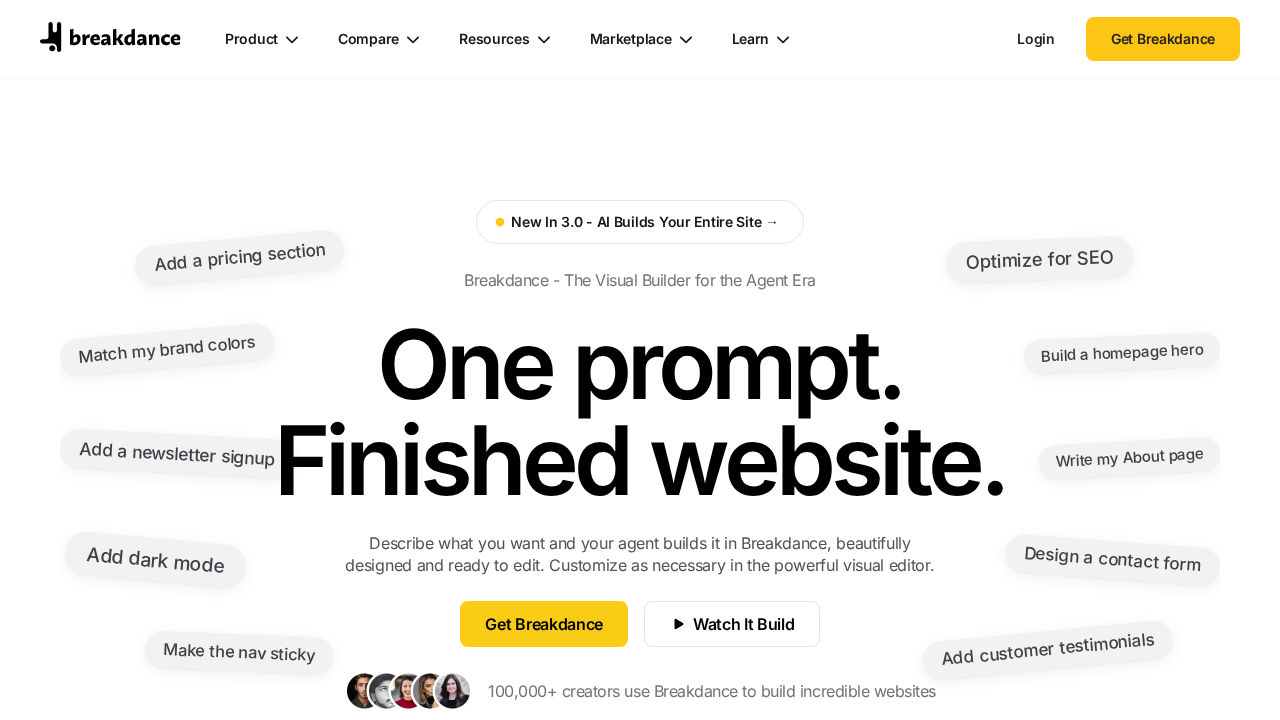
Breakdance 3.0, released in July 2026, is the most significant version to date. The headline feature is MCP-based AI site building: you can point Claude, Codex, Cursor, or another AI agent at Breakdance and build pages, templates, headers, and dynamic content through natural language prompts. Alongside that, 3.0 introduced a rebuilt Selectors system (no more automatic .breakdance wrapper class on every element), CSS Variables for a granular design token system, and native click, hover, and scroll interactions without custom JavaScript.
Version 2.8 (May 2026) added multi-element selection with bulk editing, variable fonts, conditional email templates in the form builder, and a Marquee Text element. Version 2.7 (February 2026) added WCAG 2.4.1 accessibility improvements, WP-CLI support, slider syncing, and a 50% reduction in plugin download size. The current plugin weighs 6 MB downloaded.
Who Breakdance Is Best For
Breakdance is a good fit if you:
- Build client websites where page speed and Core Web Vitals are part of the deliverable.
- Run a freelance or agency workflow and want forms, popups, WooCommerce customization, and header/footer building in one plugin without add-ons.
- Are managing multiple WordPress sites and want an unlimited-site license at a reasonable price.
- Work with WooCommerce and need full visual control over product pages, shop loops, cart, and checkout.
- Use ACF or MetaBox and want to pull custom field data into page layouts without a separate dynamic content plugin.
- Want to use AI agents (Claude, Codex, Cursor) to accelerate page-building tasks in 2026.
Breakdance is a weaker fit if you:
- Rely on a specific Elementor add-on that has no Breakdance equivalent. The third-party ecosystem is much smaller.
- Need to hand off site management to a client who is already comfortable in Elementor. There is limited community support material compared to Elementor.
- Prioritize the absolute minimum HTML output possible. Bricks Builder produces 25 to 30 KB HTML payloads and slightly better Lighthouse scores on equivalent pages.
- Are an existing Oxygen user with a lifetime license from the legacy Soflyy era. That context matters when evaluating long-term commitment to a Soflyy product.
Setup and First Impression
Installing Breakdance follows the standard WordPress plugin installation process. Upload the ZIP, activate, and the Breakdance setup screen appears.
The free version is available at breakdance.com and activates without a license key. Pro plans activate via a license key entered in the Breakdance settings panel. There is no forced account creation or cloud login.
After activation, Breakdance prompts you to choose a starting point: start from scratch, use a pre-built design set, or import an existing Breakdance site. Design sets are collections of header, footer, page, and section templates styled as a cohesive system. I found the design library functional but not as large as Elementor’s template collection.
The first thing I noticed after activation is what is missing. There is no Hello theme prompt. No theme activation suggestion. Breakdance can work alongside any WordPress theme or take over completely with Zero Theme. For existing sites, this is a meaningful difference from Elementor. Clicking “Edit with Breakdance” on any page or post opens the builder in a full-screen editor tab.
The Breakdance Editor: How It Works
The editor is built on React. Changes appear in real time on the canvas without a page reload. The layout is a four-panel setup: a left panel for elements and structure, a central canvas for real-time editing, a right-side properties panel, and a top bar with device switcher, publish controls, and document navigation.
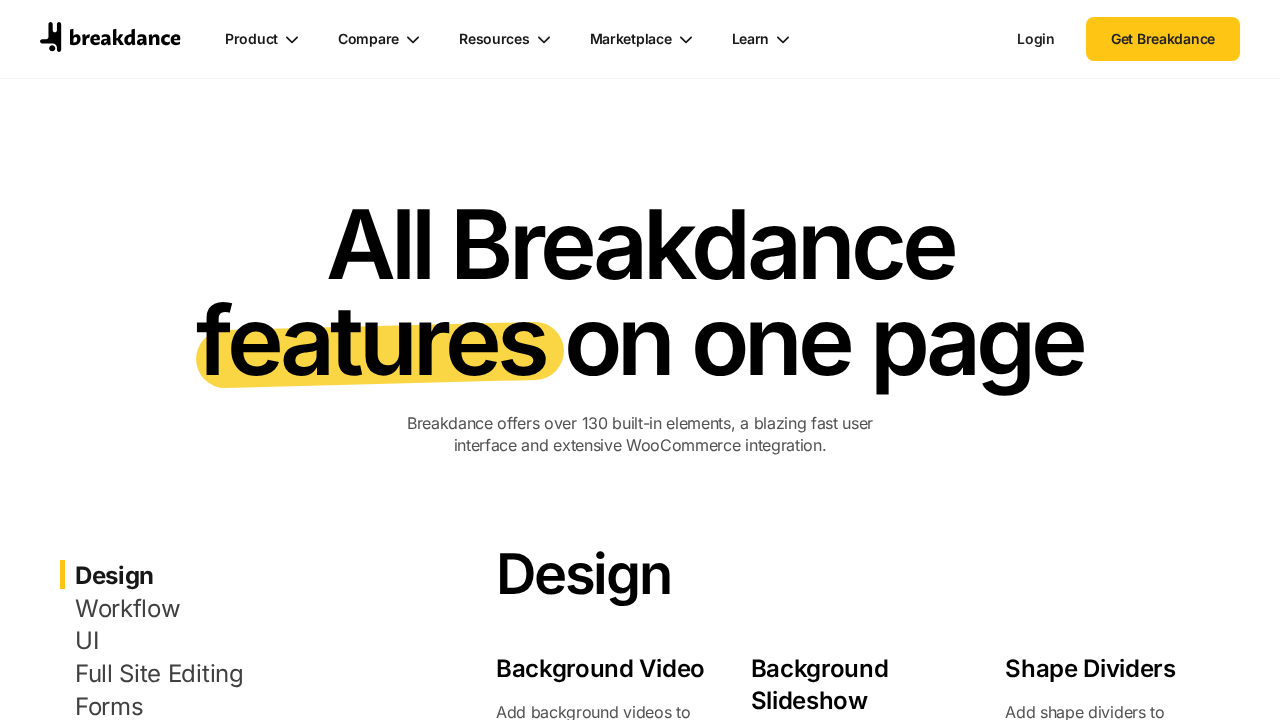
The element panel organizes 145 Pro elements (80 in the free tier) into categories: Fundamentals (new in 3.0), Layout, Text, Media, Navigation, Forms, WooCommerce, Dynamic, and more. A search box at the top filters elements by name, which is faster than scrolling categories on complex projects.
Layout uses a Flexbox engine. Containers, columns, and divs snap together with gap support and responsive ordering controls. This is more modern than Elementor’s legacy column system and produces cleaner HTML.
The Structure panel shows a tree view of all elements on the page. Right-click on any element for a context menu: duplicate, copy, paste styles, move to Global Block, wrap in container, and more. Keyboard shortcuts are available throughout.
The CSS Class Manager is a Pro feature worth mentioning. You define reusable CSS classes visually, assign them to elements, and update the class definition to change styling across all elements using it simultaneously. The Selectors system in 3.0 removes the automatic .breakdance wrapper that appeared on every element in earlier versions. Element output is now cleaner, which improves performance and makes custom CSS targeting more predictable.
Free Tier: What You Actually Get
The free Breakdance tier is genuinely different from most free-tier strategies in this market.
What is included
- 80 elements. Core layout, text, image, button, video, icon, list, accordion, tabs, slider, gallery, map, social icons, and more.
- Unlimited sites. The free plan activates on as many domains as you want. There is no per-site charge for free-tier use.
- Basic form builder: contact forms, newsletter forms, and file uploads. Form submissions are logged in WordPress admin.
- Basic popup builder: trigger popups on click, after a delay, or on exit intent.
- Basic WooCommerce integration: pre-built product page defaults and basic shop styling.
- Basic dynamic data: pull post title, featured image, custom fields, and post meta into templates.
- Full site editing: design headers, footers, archive templates, and 404 pages on the free plan.
- Revision history, undo/redo, and the global settings panel.
What requires a Pro license
- 65 additional elements (total 145 on Pro), including the CSS Class Manager, PHP Code Block, custom HTML/JavaScript blocks, and WooCommerce-specific elements.
- Full WooCommerce builder: product loop builder with facet filters, cart/checkout page builder, shop archive builder, and global store styles.
- Full dynamic data: ACF and MetaBox repeater field support, conditional display logic.
- Import/export of settings and blocks across domains.
- Adobe Fonts and custom WOFF font uploads.
- Design presets with version history.
- Pro code editor (CodeMirror 6, with Emmet support).
- Client mode / role manager.
The free tier is functional for simple sites. It hits its practical ceiling when you need dynamic data from ACF, advanced WooCommerce control, or the full element library for complex layouts.
Pro Features
Breakdance Pro adds everything the free tier omits, plus the more advanced capabilities that distinguish it from mid-market builders.
Form builder (full). Multi-step forms, conditional field logic, file uploads, reCaptcha, Honeypot spam protection, CSV export, and submission management in WordPress admin. Integrations with MailChimp, ActiveCampaign, ConvertKit, Drip, MailerLite, Zapier, Slack, Discord, and webhooks. Conditional email templates (added in 2.8): different notification emails based on form field values.
Popup builder (full). Custom triggers including click, scroll depth, time on page, exit intent, and URL/referrer conditions. Session and user-login conditions for personalized popups.
WooCommerce builder (30+ elements). Product page builder, product loop builder with facet filter integration, shop archive builder, cart and checkout page builder, quantity inputs, global store styles, and Themeless Mode for complete styling control with no theme interference.
Dynamic data (full). Post loops with ACF and MetaBox repeater field support, conditional display based on user data, WooCommerce purchase status, URL referrer, time rules, and browser/OS detection. This replaces what would otherwise require a separate dynamic content plugin in an Elementor setup.
CSS Class Manager. Define CSS classes visually with full property editors, apply them to any element, and update globally from a single panel.
PHP Code Block. Drop server-side PHP code directly onto any page or template with live preview in the editor.
MCP integration (3.0). Connect any AI agent (Claude, Codex, Cursor) to Breakdance via the Model Context Protocol. The AI can create pages, headers, footers, templates, CSS Variables, dynamic data configurations, and responsive styles directly in your Breakdance instance through natural language instructions.
CSS Variables (3.0). Define design tokens (colors, spacing, radius values, shadows) as CSS variables, reference them across all elements, and update site-wide values from a central panel.
Client mode. Restrict editor access by user role so clients can edit content without accessing builder settings or template controls.
WP-CLI support (added in 2.7). Cache clearing, URL replacement, settings import/export, license management, and system status retrieval from the command line.
Breakdance 3.0: The AI Building Layer
Breakdance 3.0 deserves its own section because it changes the positioning of the product meaningfully.
The MCP integration lets AI coding tools interact directly with Breakdance’s API. In practice, you can open a Claude or Cursor session alongside your WordPress site, describe what you want to build, and the AI generates pages, templates, headers, global styles, and responsive breakpoints inside Breakdance without manual dragging.
This is not a visual AI layout generator that drops pre-made sections onto a page. It is a programmable interface for AI agents to build and modify site structure. The distinction matters: it is more useful for technical users who work with AI coding tools than for beginners who want one-click page generation.
The rebuilt Selectors system in 3.0 means element HTML output no longer carries an automatic .breakdance wrapper class on everything. Custom CSS targeting is cleaner, and the DOM is lighter. Native interactions (click, hover, scroll) arrived in 3.0 as well: you can define show/hide, style changes, and animation triggers on click or scroll without adding custom JavaScript.
Performance
Performance is where Breakdance makes its clearest case against Elementor.
| Metric | Breakdance | Elementor | Bricks Builder |
|---|---|---|---|
| Baseline asset size | 42 KB | 570 KB | 25-30 KB |
| Average DOM nodes | 42 | 1,500+ | Lower than Breakdance |
| PageSpeed score (unoptimized) | 85-95 | 65-85 | 90-98 |
| jQuery required | No | Yes | No |
| LCP on shared hosting | ~1.1 s | ~2.5 s+ | ~0.8 s |
Breakdance loads no jQuery. CSS is cached as static files on save, not generated on every page request. Image srcset tags and responsive image handling are built in.
The gap between Breakdance and Bricks is real but smaller than the gap between Breakdance and Elementor. Bricks produces 10 to 15 KB less HTML and scores 5 to 10 points higher on Lighthouse in equivalent tests. Whether that difference matters depends on your starting point. If you are moving from Elementor, Breakdance is a significant performance upgrade. If you are a developer choosing between Breakdance and Bricks purely on Core Web Vitals, Bricks wins on raw numbers.
One caveat: there is no public benchmarking data from Soflyy broken down by hosting tier or by real-world page complexity. The 42 KB figure is the baseline asset load, not a complete page payload benchmark. Your actual results depend on how many elements you use, what images you include, and what third-party scripts load on the page.
Pricing
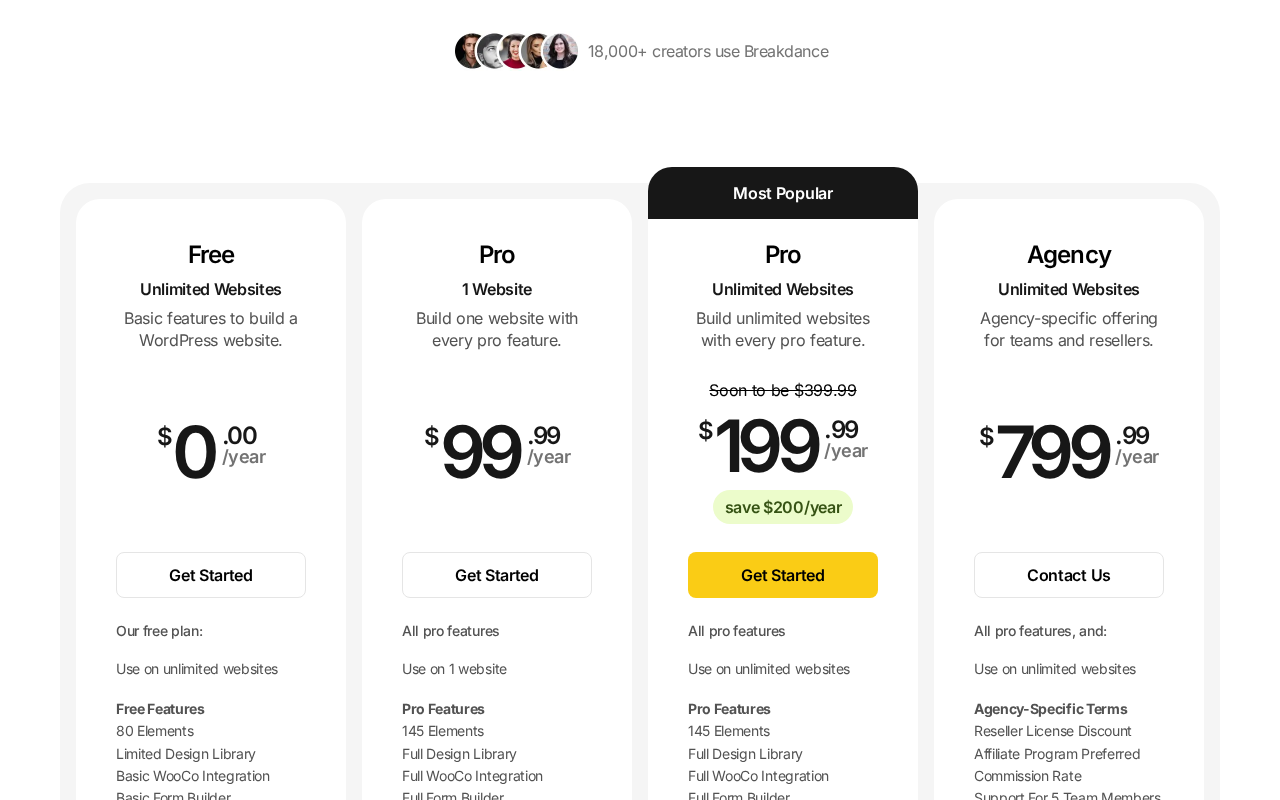
| Plan | Price | Sites | Key inclusions |
|---|---|---|---|
| Free | $0 | Unlimited | 80 elements, basic forms/popups/WooCommerce, full site editing |
| Pro – 1 Site | $99.99/year | 1 | 145 elements, full WooCommerce builder, full dynamic data, full forms, CSS Class Manager, code capabilities |
| Pro – Unlimited | $199.99/year | Unlimited | Same as Pro – 1 Site, unlimited domains |
| Agency | $799.99/year | Unlimited | Pro Unlimited features plus reseller license, preferred affiliate commission, 5 team member seats |
Price-lock guarantee. Breakdance commits to keeping renewal prices at the price you paid when you signed up. For an unlimited-site license, paying $199.99 now locks you in at that rate in future years.
Features after subscription lapse. If you do not renew, Breakdance Pro features continue working on your installed sites. You lose access to updates and support, but the plugin does not stop functioning.
60-day money-back guarantee. Breakdance offers 60 days, which is twice the standard 30-day window used by most WordPress plugin vendors.
Value comparison with Elementor. Elementor’s Expert plan (25 sites) costs $199/year. Breakdance Pro Unlimited costs $199.99/year for true unlimited sites. For agencies building more than 25 sites per year, Breakdance’s unlimited plan is a materially better deal at essentially the same annual price.
Honest Drawbacks
Soflyy’s Oxygen history. This is the most significant trust consideration for anyone evaluating a long-term commitment to Breakdance. Soflyy launched Oxygen with a lifetime license in 2017, built a loyal developer following, and then discontinued active development of Oxygen in 2022 when they launched Breakdance. Oxygen users with lifetime licenses found themselves on a product no longer receiving features or significant updates. Breakdance is sold only as an annual subscription.
Thin third-party ecosystem. Elementor has had since 2016 to build an add-on ecosystem. Plugins like JetElements, The Plus Addons, ElementsKit, and Crocoblock add thousands of extra elements, templates, and integrations. Breakdance’s third-party ecosystem is a fraction of that size.
Learning curve from other builders. Breakdance’s Flexbox-based layout engine, CSS Class Manager, and Selectors system are conceptually clean once learned, but users moving from Elementor’s section/widget mental model or from Divi’s row/column structure will need time to adjust.
No public mobile CWV benchmarks by hosting tier. The performance figures cited in Breakdance’s materials and in third-party tests are typically from controlled environments. There is limited published data on how Breakdance performs on cheap shared hosting with complex templates under real traffic conditions.
AI features require technical context. The MCP integration in 3.0 is powerful but not a beginner feature. It requires an AI tool (Claude, Cursor, or similar) to be set up and connected.
Alternatives
Elementor (free + Pro from $59/year, 1 site). The market leader with 10 million active installs. Far larger ecosystem of add-ons, templates, and third-party support. The v4 Atomic Editor introduced design-system features in 2026 that partially close the gap with Breakdance’s CSS Class system. Significantly heavier page output and higher cost for unlimited-site licensing. Choose Elementor if ecosystem depth or client handoff ease matters more than performance or feature-per-dollar value.
Bricks Builder ($79/year, unlimited sites). The performance-first developer choice. Produces slightly leaner HTML than Breakdance (25 to 30 KB vs 42 KB), higher Lighthouse scores, and a steeper learning curve. No free tier. Better fit for developers who want maximum performance. Breakdance is easier to learn; Bricks is faster.
Divi (by Elegant Themes, $89/year for all ET products). Full-site editing, extensive template library, and a Divi 5 editor that gained visual site editing in 2026. Performance typically needs more optimization than Breakdance. Worth considering if you already use other Elegant Themes products.
WordPress block editor (Gutenberg, free). For content-focused sites where layout complexity is low, it is a real option with zero performance overhead. Not a realistic replacement for Breakdance’s WooCommerce builder, form system, or conditional template logic.
Oxygen Builder (legacy, no active development). Still usable for sites already built on it, but Soflyy is no longer shipping feature updates. Not a recommendation for new builds.
Pros and Cons
Pros
- 42 KB baseline asset size and 85 to 95 PageSpeed scores without additional optimization.
- No jQuery dependency means faster page execution.
- Free tier with unlimited sites, 80 elements, and full site editing included.
- Pro Unlimited at $199.99/year with a price-lock guarantee.
- Built-in form builder, popup builder, and 30+ WooCommerce elements eliminate common add-on plugin costs.
- CSS Class Manager and CSS Variables for a real design-system workflow.
- Dynamic data (ACF, MetaBox, custom post types) built in without a separate plugin.
- MCP integration in 3.0 for AI-driven page building.
- 60-day money-back guarantee.
- Pro features continue working after subscription lapse (no site breakage on non-renewal).
- WP-CLI support for automation and deployment workflows.
- Native click, hover, and scroll interactions without JavaScript plugins.
Cons
- Soflyy discontinued Oxygen after selling lifetime licenses, which is relevant context for long-term commitment.
- Much smaller third-party add-on ecosystem than Elementor.
- Learning curve for users coming from Elementor, Divi, or Gutenberg.
- No public mobile CWV benchmarks by hosting environment.
- AI building features require a separate AI tool setup; not a beginner-facing feature.
- 100,000 users versus Elementor’s 10 million means fewer tutorials, fewer community answers, and fewer developers for hire who know the tool.
Final Verdict
Breakdance 3.0 is the strongest release the plugin has seen, and it arrives at a point where the product is genuinely competitive for a specific type of project: agency and freelance WordPress work where performance, WooCommerce, and feature completeness matter more than ecosystem size.
The price-to-value ratio is hard to argue with. $199.99/year for unlimited sites, a locked renewal price, 60-day money-back guarantee, features that replace several separate plugins, and meaningfully better performance than Elementor is a credible offer.
The honest asterisks: the Oxygen history deserves to be read before committing, the ecosystem is thin, and Bricks Builder beats Breakdance on raw performance metrics for developers who need the absolute best Lighthouse scores.
For agencies building WordPress sites at volume, Breakdance Pro Unlimited is worth a serious trial. For WooCommerce projects where performance and custom shop design are both required, Breakdance’s 30+ WooCommerce elements and Themeless Mode are genuinely useful. For performance-obsessed developers, Bricks is still the benchmark. For non-technical users who want the biggest template library and the easiest client handoff, Elementor is still the safer choice.
The free plan activates on unlimited sites with no time limit. That is the best starting point for evaluating whether the editor fits your workflow before spending anything.
FAQ
Is Breakdance free?
Yes. Breakdance has a free plan that works on unlimited sites. It includes 80 elements, a basic form builder, basic popup builder, basic WooCommerce integration, and full site editing. Pro plans start at $99.99/year for 1 site or $199.99/year for unlimited sites.
Who makes Breakdance?
Breakdance is made by Soflyy, a company that also built WP All Import (a popular data import tool for WordPress) and the legacy Oxygen Builder. Breakdance launched in 2023 as Soflyy’s successor to Oxygen.
How does Breakdance compare to Elementor?
Breakdance produces a 42 KB baseline page payload versus Elementor’s 570 KB, has no jQuery dependency, and typically scores 85 to 95 on PageSpeed without optimization. Breakdance Pro Unlimited costs $199.99/year for unlimited sites; Elementor’s comparable unlimited plan costs significantly more. Elementor has a much larger third-party ecosystem, more templates, and 10 million active installs versus Breakdance’s 100,000. Choose Breakdance for performance and value; choose Elementor for ecosystem and client familiarity.
Does Breakdance work with WooCommerce?
Yes. Breakdance Pro includes 30+ WooCommerce elements for building product pages, shop archives, product loops with facet filters, cart pages, checkout pages, and global store styles. The free tier includes basic WooCommerce defaults. Breakdance also supports Themeless Mode, which removes all theme interference and gives full visual control over WooCommerce templates.
What happens if I do not renew my Breakdance Pro license?
Breakdance Pro features continue working on your installed sites after the subscription lapses. You lose access to new version updates and support. Your live sites will not break or downgrade to the free tier.
Is Breakdance faster than Bricks Builder?
Bricks Builder produces slightly leaner output than Breakdance. Independent tests show Bricks generating 25 to 30 KB HTML payloads and Lighthouse scores of 90 to 98, while Breakdance produces 40 to 50 KB and scores 85 to 95 on equivalent pages. Both are significantly faster than Elementor. Breakdance has a gentler learning curve and more built-in features; Bricks prioritizes maximum performance and developer control.
Does Breakdance work with AI tools?
Yes. Breakdance 3.0, released in July 2026, introduced an MCP integration that lets AI agents (Claude, Codex, Cursor, and others) build pages, templates, headers, footers, and global styles directly inside Breakdance via the Model Context Protocol. This is a technical feature aimed at developers and agencies using AI coding tools, not a one-click AI layout generator.
What is Breakdance’s money-back policy?
Breakdance offers a 60-day, no-questions-asked money-back guarantee on Pro plans. This is double the 30-day standard common in the WordPress plugin market.
Does the Breakdance Pro price increase on renewal?
No. Breakdance commits to a price-lock guarantee: your renewal price stays at the rate you paid at initial purchase, indefinitely.
What are the main drawbacks of Breakdance?
The main drawbacks are the thin third-party ecosystem compared to Elementor, the learning curve for users moving from other builders, the small number of tutorials and community resources, and the Soflyy/Oxygen history (Soflyy sold Oxygen with lifetime licenses and later discontinued active development, which is relevant context for evaluating a long-term commitment to any Soflyy product).