


SureCart is not a WooCommerce clone. That distinction is worth making clear at the top, because most WordPress ecommerce plugin reviews treat every tool as a variation of the same theme. SureCart is architecturally different, and whether that difference works for or against you depends entirely on what you are building.
The plugin launched around 2021 under SureCart Inc., a company that shares its roots with the Brainstorm Force product family (Astra, Spectra, CartFlows, OttoKit). It has grown to power 40,000-plus merchant stores according to surecart.com, has collected 275 ratings on WordPress.org at 4.8 out of 5, and has been downloaded more than 3.4 million times as of July 2026. The WordPress.org active installations badge now shows 80,000-plus installations. Those are real numbers for a plugin that is only a few years old.
What this review covers and how it was researched. This is an audit-based review of SureCart version 4.5.1 as of July 2026. I reviewed the official website, pricing page, features pages, checkout builder documentation, integrations listing, WordPress.org plugin description and user reviews, and vendor-provided screenshots from the WordPress.org plugin listing. I walked through the account signup flow and the plugin’s setup requirements. Live WordPress installation, payment processor connection, and real checkout processing were not completed in this review. Where sections describe the admin UI or specific feature behavior, the basis is the WordPress.org vendor screenshots, official documentation, and the official feature pages, and those sections say so. Pricing figures are from surecart.com as of July 2026 and should be verified before purchasing.
At a glance
- Plugin version: 4.5.1 (last updated July 14, 2026)
- WordPress.org downloads: 3.4 million-plus (total cumulative downloads)
- Active installations: 80,000+ (WordPress.org badge, July 2026)
- Vendor-reported merchant stores: 40,000-plus active stores (surecart.com, July 2026)
- WordPress.org rating: 4.8 out of 5 (275 reviews)
- G2 rating: 4.7 out of 5
- Trustpilot rating: 4.4 out of 5
- Architecture: WordPress plugin plus cloud-hosted backend
- Free plan: available (with a 2.9% SureCart transaction fee)
- Paid plan from: $179 per year for one store (introductory pricing as of July 2026)
- Bottom line: the strongest WooCommerce alternative for subscriptions, digital products, and SaaS sellers on WordPress; a more complex trade-off for physical-goods stores with established WooCommerce stacks
Quick verdict
SureCart is genuinely impressive for what it includes out of the box. Subscriptions, installment plans, cart abandonment recovery, order bumps, one-click upsells, affiliate management, license key delivery, and EU VAT handling all come with the plugin at no extra cost. On WooCommerce, the same feature set would require several paid extensions totaling hundreds of dollars per year.
The trade-off is real, though. SureCart processes orders, payments, and subscription data on its own cloud infrastructure rather than on your WordPress server. That architecture brings meaningful performance benefits, but it also means your ecommerce data lives on SureCart’s servers, not in your local database. For some store owners, that is a deal-breaker.
Quick verdict
- Best for: subscription businesses, course creators, SaaS sellers, digital product stores, agencies building client stores, and merchants who want fewer plugins.
- Best fit by business type: coaches and consultants with recurring billing, software developers selling licensed products, nonprofits taking donations, and WordPress agencies managing multiple client stores.
- Standout: full subscriptions, upsells, cart recovery, affiliates, and license keys all built-in on the free plan.
- Watch out for: order and customer data stored on SureCart’s cloud (not locally); smaller extension ecosystem than WooCommerce; free plan carries a 2.9% transaction fee; newer platform with less enterprise track record.

What SureCart is
SureCart is a WordPress ecommerce plugin with an important architectural twist. The plugin itself is a WordPress-native interface: it adds menus to your admin panel, integrates with the block editor, and lets you design checkout pages using Gutenberg blocks. But when a customer places an order, the processing does not happen on your WordPress server. It happens on SureCart’s cloud platform.
SureCart calls this the plugin-plus-platform model. The WordPress plugin is the front end: product pages, checkout forms, and the customer portal. The SureCart cloud is the back end: it processes payments, manages subscriptions, handles tax calculations, and stores order data.
What this means in practice is that your WordPress database does not fill up with order data, subscription records, or payment logs. The processing load that can slow down a WooCommerce store under high traffic does not land on your server in the same way. Caching plugins work without WooCommerce-style exceptions. Plugin conflict risk from multiple extension dependencies is reduced.
What it also means is that your store’s order history, customer records, and subscription data live in SureCart’s infrastructure rather than in a database you own outright. This is an important distinction, and I will return to it in the pros and cons section.
SureCart was built by SureCart Inc., which is closely connected to the Brainstorm Force ecosystem (the company behind Astra, Spectra, CartFlows, OttoKit, and Presto Player). That connection is relevant because SureCart integrates tightly with those tools and because the development capacity behind the plugin is substantial.
Who SureCart is best for
Strong fit:
- Subscription-based businesses. Coaches, course creators, membership sites, SaaS companies, and newsletter publishers who need recurring billing without a separate paid extension. SureCart’s subscription system handles flexible billing intervals, free and paid trials, setup fees, installment plans, proration on upgrades and downgrades, and subscriber retention tools (including a “Subscription Saver” flow that offers customers pause or downgrade options before they cancel).
- Digital product sellers. Developers, designers, and content creators selling ebooks, software, templates, printables, or digital downloads. Secure file delivery is built in. License key issuance for software products is also built in at no extra cost, which makes SureCart a compelling choice for plugin developers and SaaS builders who sell through WordPress.
- Agencies managing multiple client stores. SureCart’s agency suite includes centralized store management, service fee charging, and client account management. Removing transaction fees on Pro plans and the ability to manage multiple stores under one account makes the agency workflow significantly more manageable than running separate WooCommerce installs per client.
- Merchants who want fewer moving parts. If you have spent time resolving WooCommerce plugin conflicts, managing update cascades across a stack of premium extensions, or debugging broken checkouts after theme updates, SureCart’s consolidated architecture is a serious quality-of-life improvement.
- Nonprofits and fundraisers. SureCart supports one-time and recurring donations out of the box. No additional plugin is needed to handle donation-style pricing.
- Physical product stores starting fresh. SureCart handles inventory, shipping, fulfillment, and returns. The setup is cleaner than WooCommerce for stores that do not need WooCommerce’s deep third-party extension ecosystem.
Weaker fit:
- Established WooCommerce stores with custom stacks. A working WooCommerce installation with custom development, specific paid extensions, and an existing order history in your database makes migration to SureCart a significant project. The data migration path is not seamless.
- Merchants who require local data ownership. SureCart’s cloud model means order and customer data lives on SureCart’s servers. For businesses with GDPR data residency requirements, high-compliance industries, or simply a strong preference for owning their database, this is a real limitation.
- Stores needing WooCommerce’s specific extension ecosystem. WooCommerce has hundreds of niche extensions for specific industries, shipping carriers, fulfillment services, and payment gateways. If your store depends on a WooCommerce-specific integration that has no SureCart equivalent, switching is not realistic.
- High-volume physical goods stores at scale. SureCart has demonstrated strong performance for digital and subscription businesses. Its track record for very large physical goods stores with complex inventory and fulfillment workflows is less established than WooCommerce’s 15-year history.
Installation and setup
SureCart installs from the WordPress plugin directory. You search for “SureCart” under Plugins > Add New, install, and activate. The plugin package is lightweight by ecommerce standards.
One important step comes immediately on activation: SureCart requires a free account at app.surecart.com before the plugin can function. The cloud backend is mandatory. If you prefer to avoid a third-party account dependency, that is worth knowing before you install. The signup form asks for your name, email, and password, then prompts you to name your store and choose a currency.
Once connected, the plugin creates a new “SureCart” section in the WordPress admin menu. Based on the vendor’s WordPress.org description, the initial onboarding covers the most common setup decisions in order:
- Payment processor connection (Stripe, PayPal, Mollie, or Razorpay)
- Tax settings (automated for US sales tax and EU VAT, or manual override)
- Shipping setup (for physical product stores)
- Product creation
The vendor describes a basic product being ready to sell in under 15 minutes from plugin activation. The admin panel has its own distinct visual style: clean, modern, and significantly less cluttered than WooCommerce’s tabbed settings architecture. The key settings areas visible in the WordPress.org vendor screenshots include Subscriptions, Subscription Saver, Affiliates, Taxes, Shipping, Payment Processors, and Currencies.
Products and pricing options
SureCart supports six product types:
- Physical products (with shipping, inventory, and fulfillment)
- Digital products (with secure file delivery)
- Services (one-time or recurring)
- Subscriptions (recurring with flexible billing)
- Licenses (software license key issuance and management)
- Donations (one-time or flexible recurring)
What separates SureCart’s product setup from WooCommerce’s is the pricing model. A single SureCart product can carry multiple pricing options simultaneously. You can attach a one-time price, a monthly subscription price, an annual subscription price, and an installment plan to the same product. The customer selects which option works for them at checkout.
This removes the need to duplicate products for different billing models, which is a meaningful simplification for SaaS sellers and course creators.
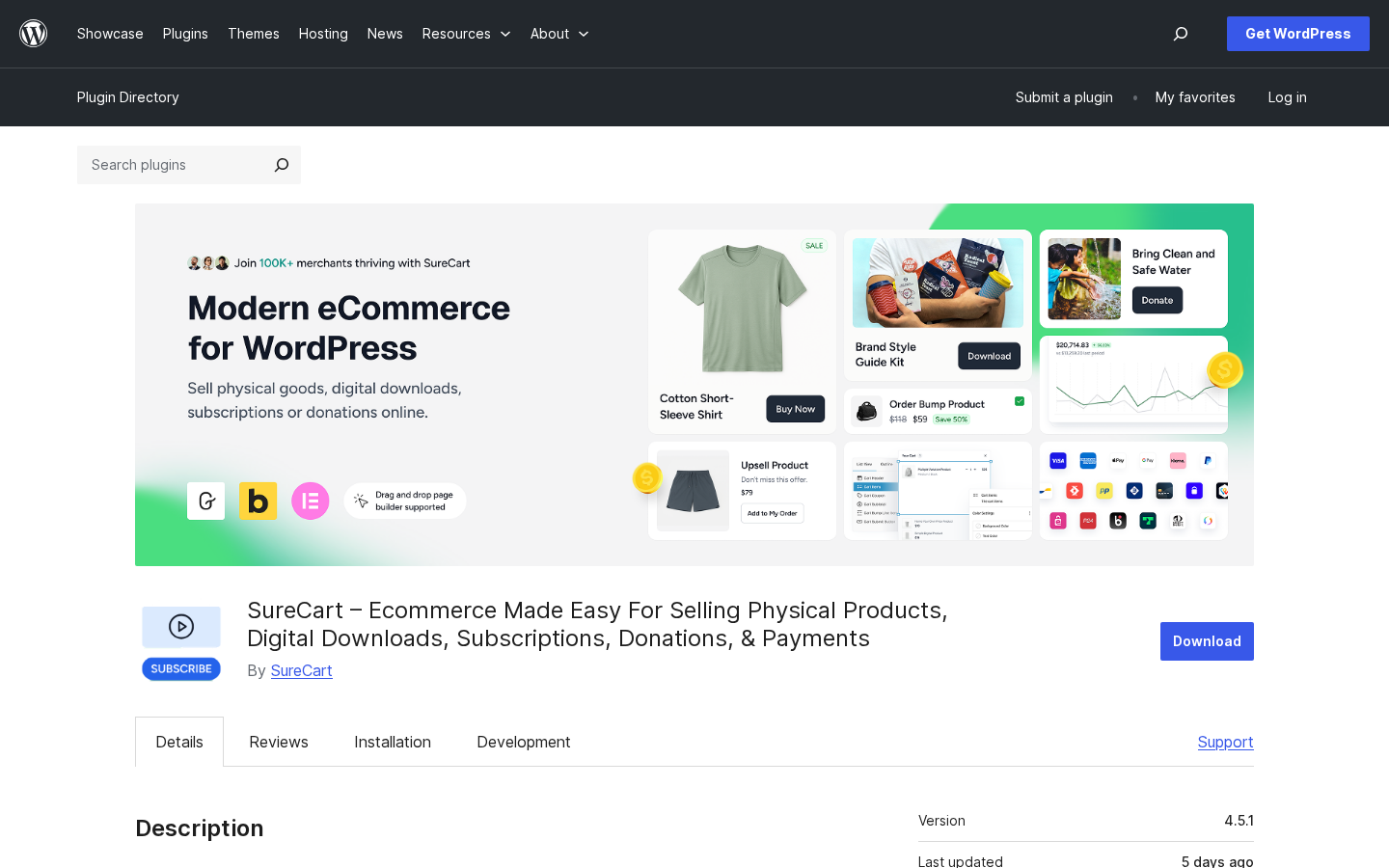
The vendor-provided WordPress.org screenshot below shows the product grid in action: a physical t-shirt with a sale price, a physical bundle, a digital Style Guide Kit, a subscription “Choose Your Plan” widget (Plus $9.99/month versus Pro $29.99/month with Monthly/Yearly toggle), and a donation product, all living side by side. This illustrates how SureCart handles all product types from one platform.

Dynamic Pricing is a newer addition. It lets prices adjust automatically at checkout based on conditions: discount when cart total exceeds a threshold, bulk pricing for quantity orders, BOGO-style rules, role-based pricing for logged-in customers, and conditional fees by customer type. These rules apply at checkout without requiring separate coupon codes or product duplicates.
Product variants (size, color, format) are supported with individual pricing, media, and inventory per variant. Collections group products into browsable categories. Line-item notes allow customers to add custom input (engravings, special instructions) at checkout.
The checkout experience
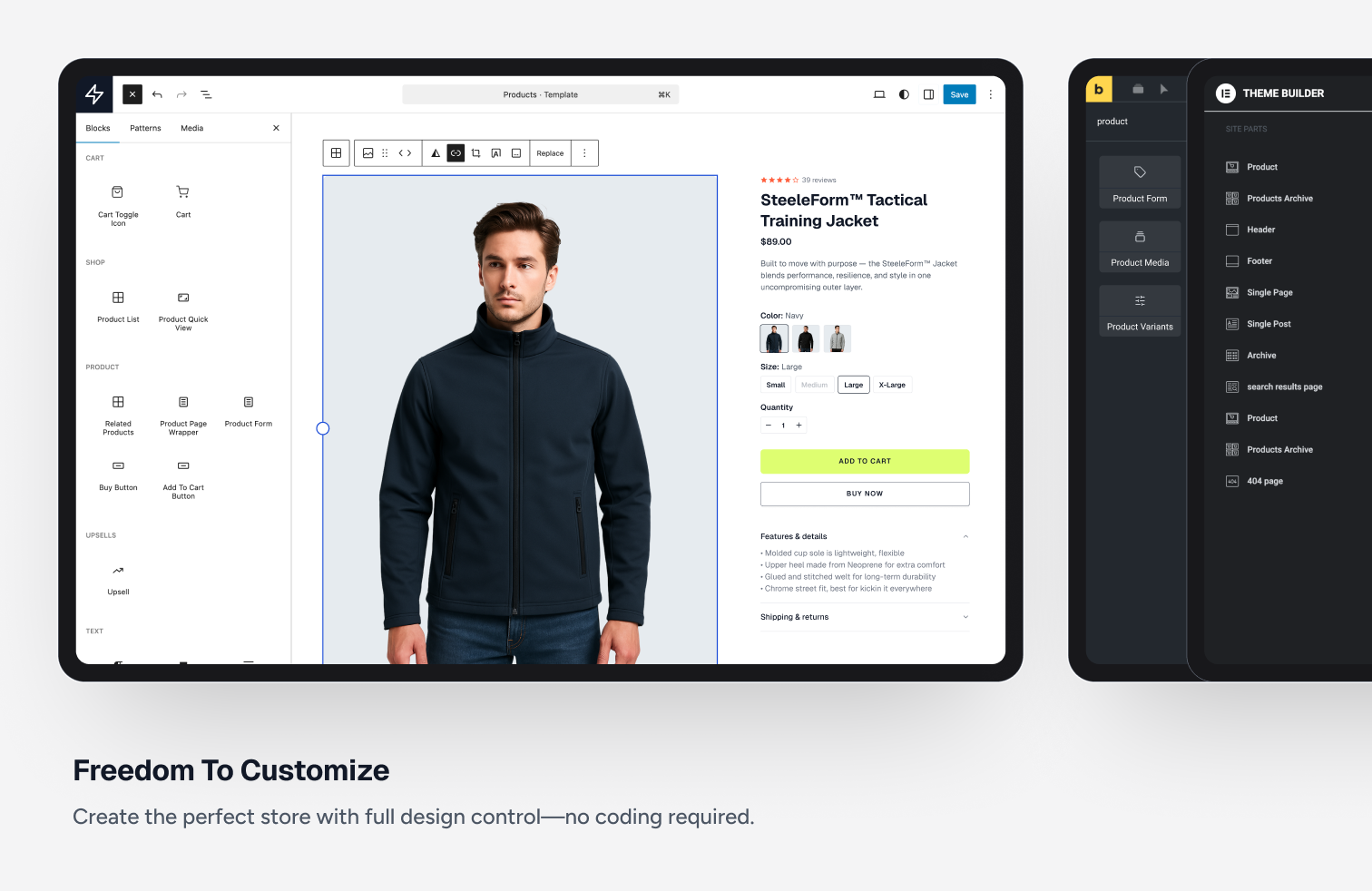
SureCart’s checkout is built with Gutenberg blocks, which means the checkout page is editable inside the WordPress block editor using drag-and-drop. The vendor’s WordPress.org listing shows SureCart integrating with Bricks Builder’s theme builder (screenshot below), where dedicated SureCart blocks appear in the left panel: Cart Toggle Icon, Cart, Product List, Product Quick View, Product Form, Buy Button, Add To Cart Button, Upsell, and more. The right panel shows site parts (Product, Products Archive, Header, Footer, Single Page) editable as templates.
Pre-built templates include a standard layout, a minimal one-step layout, a two-column product-focused layout, donation-specific templates, invoice templates, and full-page layouts.
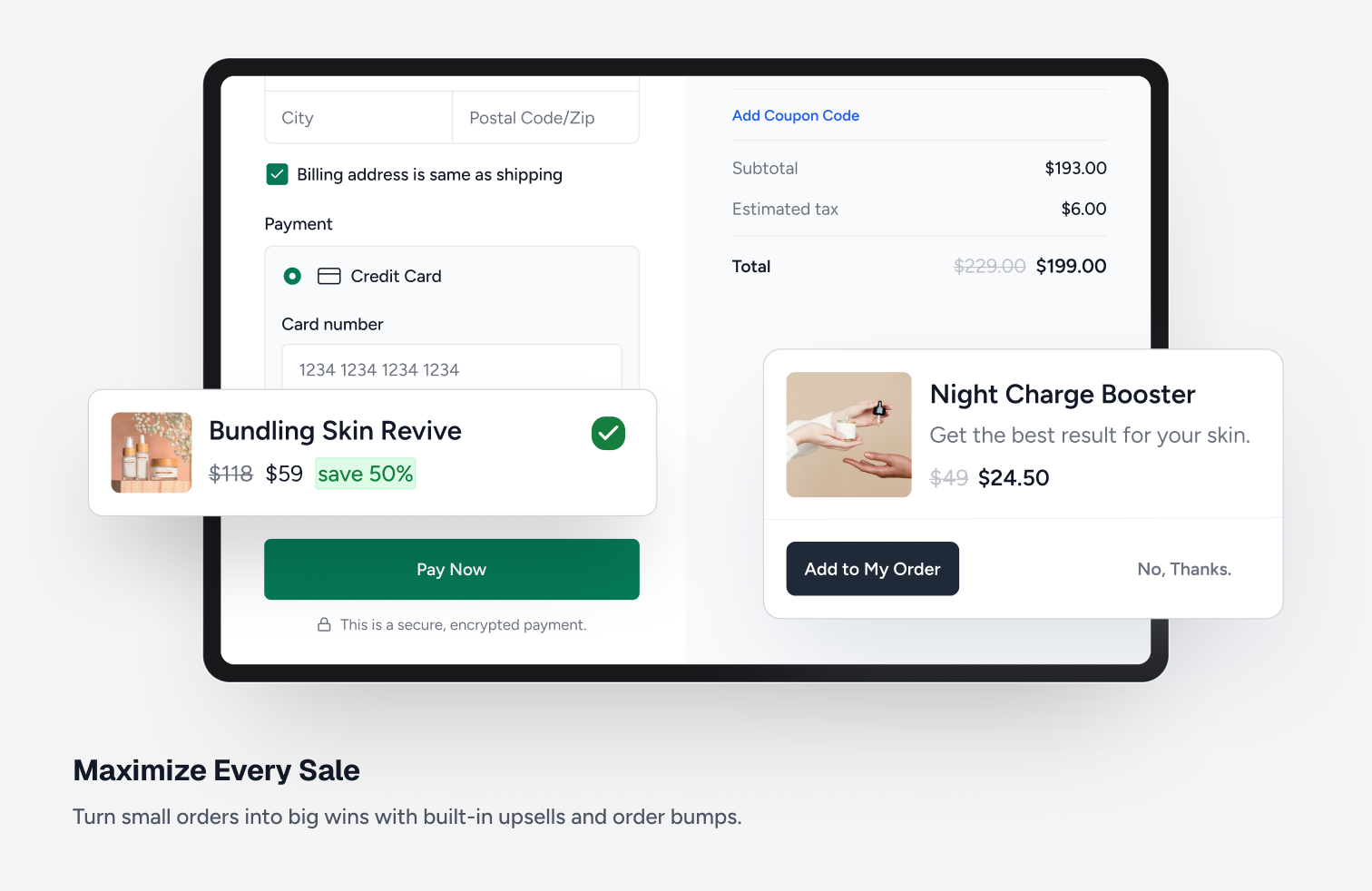
The checkout form in use shows the clean design philosophy: city/postal code fields, a “Billing address is same as shipping” checkbox, a Credit Card payment section, order summary with coupon code field, subtotal ($193), estimated tax ($6), and a discounted total ($229 crossed through to $199), plus a “Pay Now” button with “This is a secure, encrypted payment” trust note.
Conditional fields let you show or hide checkout form sections based on cart conditions: total above or below a threshold, specific products in the cart, an applied coupon code, billing country, or active payment processor. This reduces friction for customers who only see fields relevant to their purchase.
Instant checkout links generate a dedicated checkout URL per product. You can share the link directly, embed a buy button anywhere, or send it as a payment link to clients.
Express payments work natively. When Stripe is connected, Apple Pay and Google Pay appear in the checkout automatically. Customers with cards saved in their browser or device complete the purchase with a single tap.
Pre-filled checkout links support URL parameters that auto-populate customer fields: email, name, and coupon codes. Useful for email campaigns or client invoices where you want to reduce friction for known customers.
Subscriptions and recurring revenue
Subscriptions are included in all SureCart plans, including the free tier. This is the sharpest contrast with WooCommerce, where WooCommerce Subscriptions costs approximately $249 per year.
SureCart’s subscription system covers:
- Daily, weekly, monthly, yearly, and custom billing intervals
- Free trials and paid trials
- Setup fees and setup discounts
- Installment plans (split a one-time price into multiple payments)
- Multiple subscription options per product
The retention layer sets SureCart apart from simpler subscription plugins. When a customer tries to cancel, SureCart can present them with options: downgrading to a cheaper tier, pausing the subscription for a set period, or changing billing frequency. This “Subscription Saver” flow is configurable and aimed at reducing voluntary churn.
Dunning management handles failed payment recovery automatically. When a subscription payment fails, SureCart sends automated retry sequences and notifies the customer to update their payment method. Customers can update payment details themselves through the self-service customer portal without contacting support.
Subscription upgrades and downgrades are prorated. If a customer moves from a monthly to an annual plan mid-cycle, SureCart calculates the remaining credit and applies it to the new plan automatically. This removes a common support headache for subscription-based businesses.
Revenue boosters: upsells, order bumps, and cart abandonment
All three revenue-boosting features are included in every SureCart plan.
Order bumps appear at checkout as a checkbox or mini-product card. Customers can add a related item with one click before paying, with no page redirect. The vendor screenshot above (checkout section) shows an accepted order bump for “Bundling Skin Revive” at $59 (save 50%).
One-click upsells appear after payment is completed. The customer sees a post-purchase offer and can accept it without re-entering payment details, because SureCart already has the card on file. The same screenshot shows a “Night Charge Booster” upsell at $24.50 with “Add to My Order” and “No, Thanks.” options.
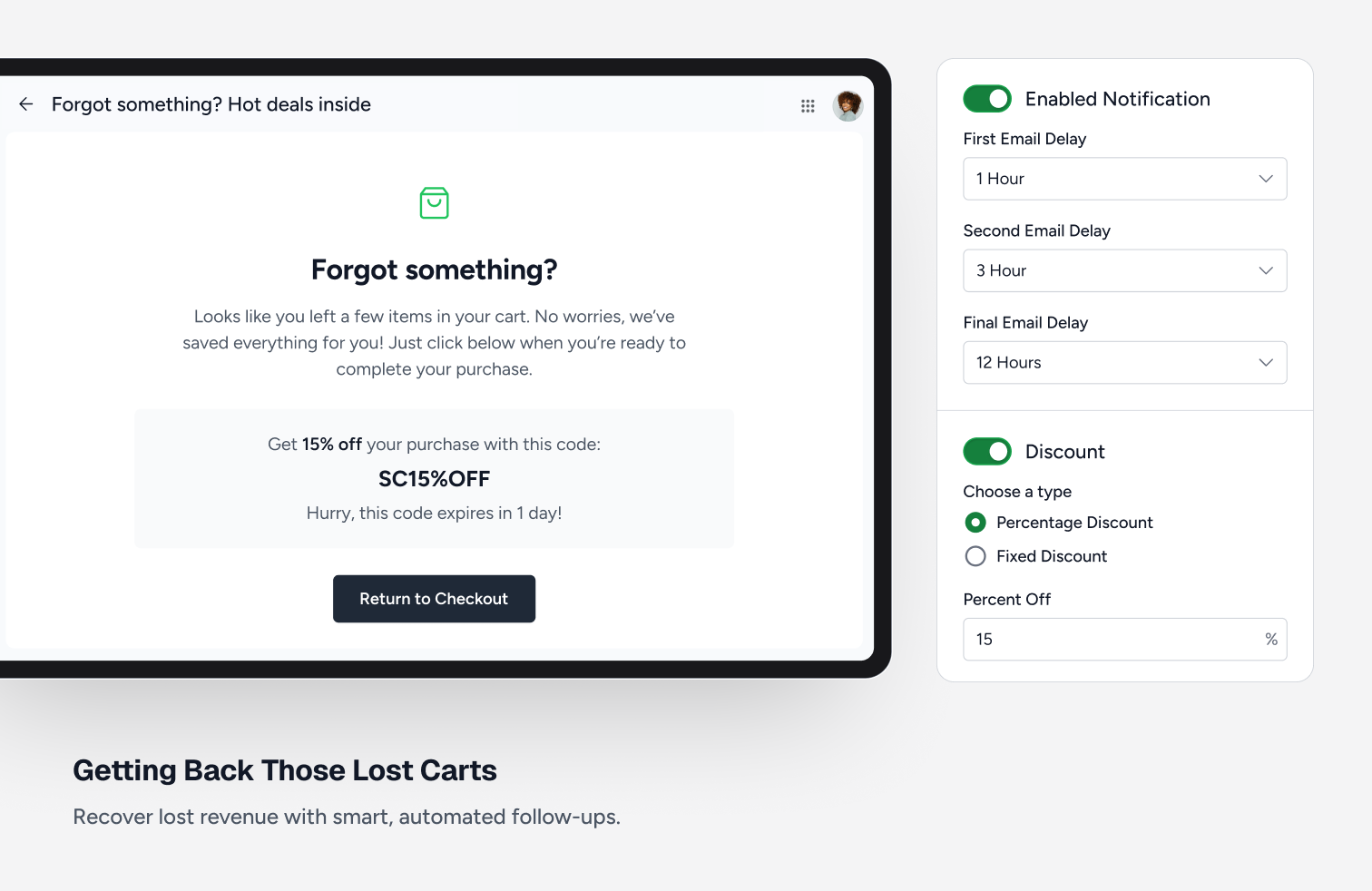
Cart abandonment recovery tracks checkout sessions that were started but not completed. SureCart sends a configurable sequence of follow-up emails automatically. The vendor’s WordPress.org screenshot below shows the abandonment email template alongside the admin configuration panel: Enabled Notification toggle, First Email Delay (1 Hour), Second Email Delay (3 Hour), Final Email Delay (12 Hours), and a discount option (Percentage Discount at 15%, generating coupon code SC15%OFF). No third-party email marketing platform is required for the basic recovery sequence.
Price Boost is an additional feature that displays crossed-out original pricing to encourage conversion.
Affiliate platform
SureCart includes a built-in affiliate management system. The vendor-provided screenshot below shows the actual Affiliates settings panel inside the SureCart admin. The left navigation sidebar shows the full settings menu: Subscriptions, Subscription Saver, Affiliates (currently active), Taxes, Shipping, Payment Processors, and Currencies. The main panel shows Referral Tracking configuration: a Tracking toggle (enabled), Referrer Type dropdown (Last), Tracking Length (30 days), Auto Approve New Referrals toggle, and Affiliate Referral URL field.
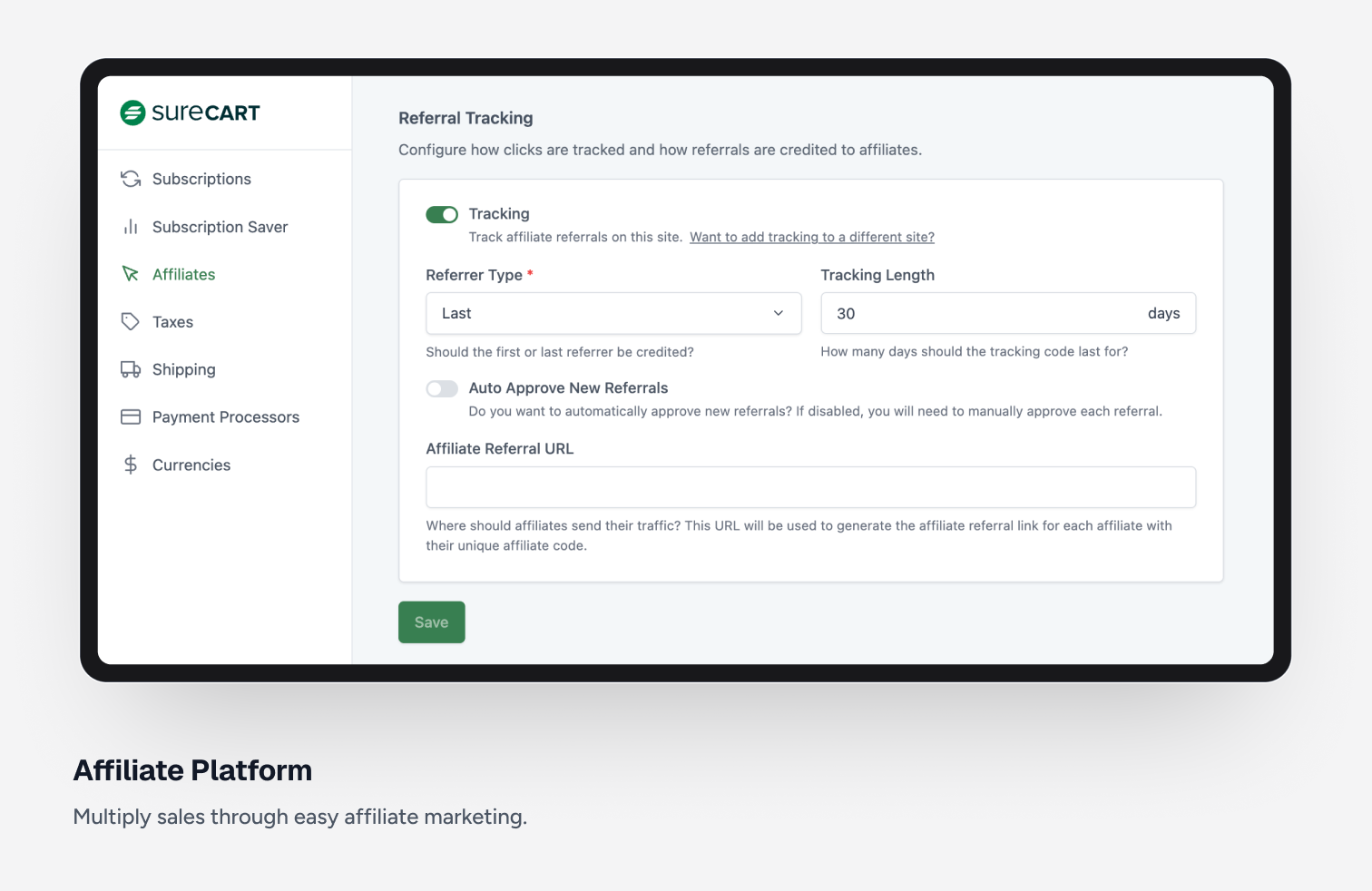
You can set commission rates per product or at the store level, generate affiliate links, and track conversions and payouts from the admin dashboard. Affiliates get a self-service portal to track their earnings.
This is a feature that typically requires a dedicated affiliate plugin ($99 to $299 per year on WooCommerce). Having it included is a genuine differentiator for course creators and software sellers whose growth depends on affiliate distribution.
Payments and currencies
SureCart connects to four payment processors: Stripe, PayPal, Mollie, and Razorpay. You can run multiple processors on a single checkout form simultaneously, letting customers choose their preferred option.
Supported:
- 100-plus payment methods across all connected processors
- 135-plus currencies
- Apple Pay and Google Pay (via Stripe, shown automatically in the checkout)
- Buy Now Pay Later options (where supported by the connected processor)
- Local payment methods (Mollie covers a wide range of European bank and wallet options)
SureCart does not charge a transaction fee on Pro plans. On the free Launch plan, a 2.9% fee applies to all orders processed through SureCart, in addition to your payment processor’s standard fees.
For a store doing $5,000 per month in revenue, the SureCart free-plan transaction fee costs approximately $145 per month ($1,740 per year). A Pro plan at $179 per year eliminates that fee entirely and pays for itself quickly at any meaningful order volume.
Tax and compliance
Automated tax calculation is included in all SureCart plans:
- US sales tax (covers 40-plus states)
- EU VAT (with automatic VAT number validation and verification)
- AU GST and other supported countries
- Manual tax overrides per product for exceptions
EU VAT handling in particular is a common pain point on WooCommerce, where the official WooCommerce EU/UK VAT Compliance extension starts at around $79 per year. SureCart includes it at no extra cost.
Sequential order numbers for invoice and compliance record-keeping are also built in.
Shipping and physical products
SureCart supports physical product sales with shipping zones, flexible shipping rate rules, and fulfillment tracking.
Built-in shipping features:
- Flat rate and free shipping (conditionally triggered by cart total or coupon)
- Weight-based and quantity-based shipping rules
- Shipping zones by country and region
- Fulfillment management (mark orders as fulfilled, track shipping status)
- Returns and refunds processing from the admin dashboard
- Inventory tracking per product and variant
Live carrier rate integration (real-time UPS, FedEx, USPS rates) is not natively available in the same way WooCommerce offers it through carrier extension plugins. For stores that need live carrier quotes, this is a gap to verify against current SureCart documentation before committing.
Product reviews
SureCart includes a native product review system. Customers can leave star ratings and written feedback after purchase. Reviews are moderated inside the SureCart dashboard and display on product and checkout pages as verified-purchase feedback.
This removes the need for a separate reviews plugin. Having a moderated review system tied to purchase verification improves trust signals without adding plugin overhead.
Analytics and reporting
The SureCart admin dashboard provides a real-time sales overview with:
- Revenue by date range
- Order count and status breakdown
- Subscription metrics (active, cancelled, paused)
- Customer lifetime value
- Cart abandonment statistics
- Product performance
The reporting covers the core metrics a store owner needs for daily monitoring. For deeper analytics, SureCart integrates with Google Analytics 4, Facebook Pixel, and Conversion Bridge for multi-channel attribution.
What SureCart’s native reporting does not include: cohort analysis, advanced funnel visualization, or inventory forecasting. These require connecting an external analytics tool.
Developer tools and extensibility
SureCart provides a full REST API, webhooks, and a WordPress action and filter hook system for custom integrations. The hook architecture follows WordPress conventions, so developers familiar with WooCommerce development can adapt quickly.
Key developer features:
- Full REST API for products, orders, customers, and subscriptions
- Webhooks for real-time event notifications (order paid, subscription created, etc.)
- WordPress action and filter hooks for modifying behavior without editing core files
- License key management API for software product automation
- OttoKit and Zapier integration for no-code automation
The architecture around webhooks and API access is well-suited to building headless or hybrid setups where WordPress handles content and SureCart handles commerce.
Agency features
The agency suite is included in all SureCart plans. It covers:
- Central management of multiple client stores from one account
- Service fee charging (add a percentage or flat fee on top of client subscription billing)
- Client commissions (earn a percentage of client store revenue)
- Client accounts with role-based access control
For freelancers and agencies that build and manage ecommerce sites, this is a compelling add-on. The ability to earn ongoing commissions from client stores without adding per-client extension costs changes the economics of agency ecommerce work.
Integrations
SureCart integrates with a focused set of platforms. As of July 2026, key integrations include:
| Category | Integrations |
|---|---|
| Page builders | Gutenberg, Bricks Builder, Elementor, Kadence |
| Automation | OttoKit, Zapier, WPFusion, Flowmattic, Integrately, Pabbly Connect |
| Courses and LMS | LearnDash, LifterLMS, TutorLMS, Masteriyo |
| Community | BuddyBoss, SureDash |
| Membership | SureMembers |
| Analytics | Google Analytics, Facebook Pixel, Conversion Bridge, Independent Analytics |
| Gamification | GamiPress |
| CRM and email | WPFusion (connects to most major CRMs) |
| Payment processors | Stripe, PayPal, Mollie, Razorpay |
The integration list is shorter than WooCommerce’s ecosystem. That is expected for a newer platform. The most important gaps, compared to WooCommerce, are in niche payment gateways, specific shipping carrier plugins, and industry-vertical extensions. If your store runs on a niche integration that is not listed, verify with SureCart support whether it is supported before switching.
Pricing
SureCart’s pricing is structured around the number of stores and whether you pay annually or once.
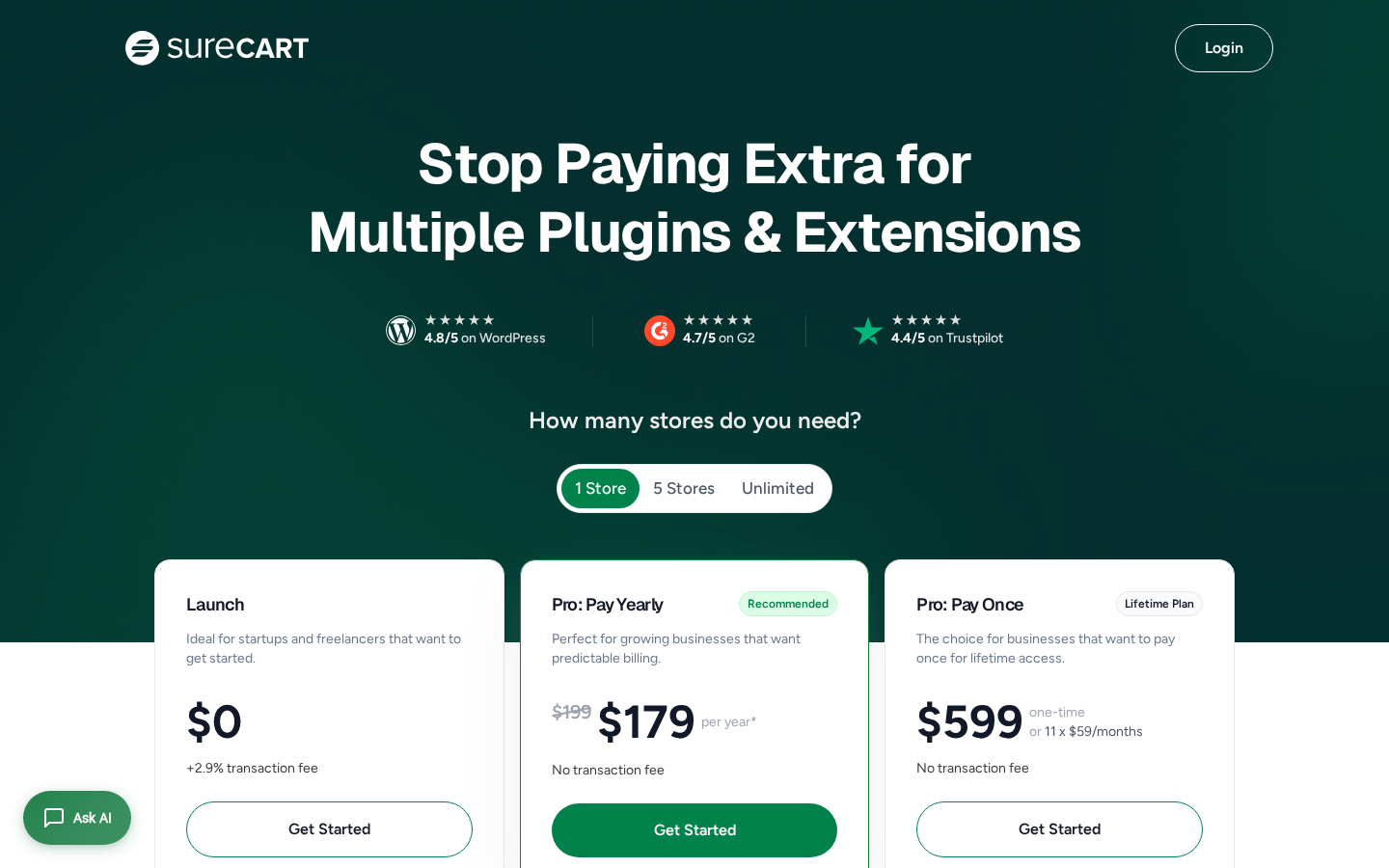
Free (Launch) plan
- $0 per month
- All core features, including subscriptions, upsells, order bumps, cart abandonment, and affiliate management
- 2.9% SureCart transaction fee on every order (in addition to payment processor fees)
- Unlimited products
- 1 store
The free plan is genuinely functional. There is no feature gating that forces you to upgrade to access subscriptions or revenue tools. The only upgrade driver is the transaction fee: at any meaningful revenue volume, paying $179 per year to eliminate a 2.9% fee is straightforward math.
Pro plan (1 store)
- $179 per year (introductory; $199 at renewal per SureCart pricing notes)
- Or $599 one-time (lifetime access, paid in full or in 11 installments of $59)
- No transaction fee
- All features included
Pro plan (5 stores)
- $249 per year (introductory; $299 at renewal)
- Or $999 one-time (lifetime access, paid in full or in 11 installments of $99)
- No transaction fee
Pro plan (unlimited stores)
- $399 per year (introductory; $499 at renewal)
- Or $1,699 one-time (lifetime access, paid in full or in 11 installments of $169)
- No transaction fee
Feature parity across all plans. SureCart explicitly markets this: every feature is available on every plan, including the free tier. The difference between free and paid is only the transaction fee and the number of stores.
14-day money-back guarantee on all paid plans.
How this compares to WooCommerce
To replicate SureCart’s built-in feature set on WooCommerce (at approximate July 2026 prices from the WooCommerce extensions marketplace):
| Feature | WooCommerce equivalent | Approximate cost |
|---|---|---|
| Subscriptions | WooCommerce Subscriptions | ~$249/year |
| Abandoned cart recovery | Third-party plugin | ~$99-149/year |
| Order bumps and upsells | CartFlows or similar | ~$99-199/year |
| Affiliate management | Dedicated affiliate plugin | ~$99-249/year |
| EU VAT | WooCommerce EU/UK VAT extension | ~$79/year |
| License key management | Dedicated license plugin | ~$99-149/year |
| Built-in product reviews | Separate review plugin | ~$49-99/year |
Replicating just this list on WooCommerce would cost approximately $773 to $1,173 per year in additional extensions alone, compared to SureCart’s $179/year Pro plan for a single store. The comparison is not perfectly equivalent (WooCommerce has more extension depth in some areas), but the cost structure is a real difference.
Pros and cons
Pros
- Free plan with full feature access: subscriptions, upsells, order bumps, cart abandonment, and affiliates all included.
- Cloud-hosted back end reduces WordPress server load, database bloat, and plugin conflict risk.
- Subscription management is the most complete available on a free WordPress ecommerce plugin, including dunning, proration, and voluntary churn reduction tools.
- License key management built in at no extra cost, making SureCart the clearest choice for WordPress plugin and SaaS developers.
- Affiliate platform built in, with configurable tracking, commission rates, and referral URLs (visible in admin settings).
- Checkout builder works with Gutenberg blocks natively and supports Bricks Builder and Elementor; pre-built templates reduce setup time.
- Apple Pay and Google Pay activate automatically via Stripe, no extra configuration needed.
- EU VAT handling, US sales tax, and AU GST all automated and included.
- Product review system built in.
- Dynamic Pricing for BOGO, bulk, role-based, and cart-total-based pricing rules.
- Agency suite included on all plans: central client management and commission earning.
- Tight integration with Brainstorm Force tools (Astra, Spectra, CartFlows, OttoKit).
- 4.8/5 stars from 275 reviews on WordPress.org; 4.7/5 on G2. Consistent positive feedback on support response quality.
- 14-day money-back guarantee on paid plans.
- Works natively with Gutenberg, Bricks Builder, and Elementor.
Cons
- Order data, customer records, and subscription history are stored on SureCart’s cloud servers, not in your local WordPress database. If you require local data ownership, or if SureCart’s business is ever disrupted, data portability becomes a real concern. Multiple WordPress.org reviewers (including a July 2026 review) flagged this as a reason for not adopting the plugin.
- The plugin requires a mandatory third-party account (app.surecart.com). There is no fully self-hosted deployment option; the cloud backend cannot be removed.
- Free plan carries a 2.9% SureCart transaction fee on top of your payment processor’s own fees. At moderate revenue, this fee costs more per year than buying the Pro plan.
- Smaller extension ecosystem than WooCommerce. Niche shipping carriers, specific payment gateways outside Stripe/PayPal/Mollie/Razorpay, and industry-vertical features may not have SureCart integrations.
- Newer platform (launched 2021). Less battle-tested for very high-volume or enterprise-scale stores compared to WooCommerce’s 15-year track record.
- Pro pricing at $199/year per store becomes expensive for agencies managing many low-revenue client stores.
- Live carrier shipping rate integrations (UPS, FedEx, USPS real-time rates) are not confirmed natively; verify current support before committing.
- Not ideal for stores that already run complex WooCommerce customizations with no migration path.
Alternatives to SureCart
- WooCommerce. The most widely used WordPress ecommerce plugin, with 7-plus million active installs and a 15-year history. Choose WooCommerce if you need a deep third-party extension ecosystem, specific carrier integrations, or a fully self-hosted ecommerce solution where data never leaves your server. The free core plugin is powerful; advanced use cases (subscriptions, bookings, memberships) require paid extensions that add significant annual cost.
- Easy Digital Downloads. A WordPress plugin focused specifically on digital product sales: software, PDFs, audio, video, and downloadable files. EDD is simpler than both WooCommerce and SureCart for pure digital stores but lacks SureCart’s subscription management depth and revenue tools. Extension costs are lower than WooCommerce but add up similarly.
- WP Simple Pay. A Stripe-focused payment plugin for WordPress. Suitable for simple payment forms, subscriptions, and donation collection without a full storefront. Less suitable if you need a product catalog, inventory management, or post-purchase upsells.
- FluentCart. A newer WooCommerce alternative from the WPManageNinja team. Still maturing in features and install base but worth monitoring as a self-hosted alternative for buyers who specifically want local data storage.
- Shopify (with WordPress). Not a WordPress plugin, but an option for merchants who want managed hosting, a proven large-store track record, and the widest app ecosystem in ecommerce. Shopify charges $39 to $399 per month plus a transaction fee (0.5% to 2%) if you do not use Shopify Payments. Best if WordPress is not a hard requirement.
- CartFlows. Made by the same Brainstorm Force family as SureCart, CartFlows is a funnel and checkout builder that sits on top of WooCommerce. If you want to stay on WooCommerce and improve your checkout experience with upsells and order bumps, CartFlows is the adjacent tool from the same team.
Final verdict
SureCart is the most compelling WooCommerce alternative for WordPress users who primarily sell subscriptions, digital products, software licenses, or services. Its core differentiators are real: cloud-hosted processing that removes database bloat and conflict risk, a built-in subscription engine that rivals paid WooCommerce extensions, and a unified feature set that eliminates the plugin stack most WooCommerce stores accumulate.
The pricing structure is straightforward and fair. The free plan is functional enough to validate a business idea before spending anything, and the Pro plan pays for itself quickly once order volume makes the transaction fee a meaningful line item.
The hosted-data architecture is the most significant consideration to work through before committing. Your store’s order history and customer data will live on SureCart’s servers. For most small and mid-size businesses, this is a non-issue: SureCart handles backups, infrastructure, and PCI compliance as part of the service. For businesses with strict data residency requirements or a strong preference for full data ownership, it is a genuine limitation.
For merchants building fresh on WordPress with recurring revenue or digital product goals, SureCart is the cleanest path to a full-featured store in 2026. For merchants with established WooCommerce stores and custom extension stacks, the migration cost likely outweighs the operational benefits.