


Most WordPress ecommerce plugins start from the same assumption: you have physical products to ship, and digital downloads are a feature you tack on later. Easy Digital Downloads starts from the opposite place.
It was built in 2012 specifically for digital product sellers. Not as an afterthought extension to a physical-goods framework, but as a focused platform designed around one job: selling files, software, and digital content directly from WordPress. That founding decision still shapes everything about how the plugin works in 2026.
What this review covers and how it was researched. This is a hands-on review of Easy Digital Downloads version 3.6.9 as of July 20, 2026. I installed and activated the free Lite plugin in a local WordPress sandbox (wp-now, WordPress 7.0.2, SQLite backend), completed all four steps of the EDD setup wizard (business type, payment method, store pages, and tools), and created and saved a sample Download product (“Sample eBook: Quick Start Guide”) with a $9.99 price and a PDF file attachment. I navigated all major admin sections: the Downloads list, the full EDD Settings panel (General, Store Pages, Gateways, Emails tabs), plus the Reports, Customers, and Orders dashboards. I confirmed the wizard-generated checkout and purchase history pages are accessible on the frontend. I did not complete an end-to-end payment transaction in the sandbox. Paid-plan features (subscriptions, software licensing, content restriction, abandoned cart recovery) require a paid plan and are described based on official EDD documentation, the vendor’s features page, pricing page, and changelog. Pricing figures are from easydigitaldownloads.com as of July 2026 and should be verified before purchasing.
At a glance
- Plugin version: 3.6.9 (last updated June 18, 2026)
- Active installs: 40,000-plus (WordPress.org)
- WordPress.org rating: 4.7 out of 5 (588 reviews; 535 five-star, 34 one-star)
- Vendor-reported stores: 50,000-plus in 187 countries
- Vendor-reported orders processed: 30 million-plus
- Free plugin: yes (Lite, available on WordPress.org)
- Paid plans start at: $99.50 per year (introductory; renews at $199)
- Bottom line: the most purpose-built WordPress plugin for digital product sellers, with a mature free tier and a pricing model that rewards careful plan selection
Quick verdict
Easy Digital Downloads does digital ecommerce well because it has been doing only that for over 13 years. The free tier is genuinely functional: unlimited products, unlimited transactions, Stripe and PayPal integration, a checkout block, customer management, and reporting are all there without paying anything. That is a real foundation for a new digital product store.
The catch is that the features most digital sellers need most, including subscriptions, software licensing, abandoned cart recovery, and content restriction, live behind paid plans. And the renewals on those plans are significant: the introductory prices cut the first-year cost in half, but annual renewals run at $199, $399, $599, or $999 depending on the tier.
- Best for: ebook sellers, software developers selling plugins/themes, course creators, digital artists, and any WordPress-based business where every product is a file or a license key.
- Best fit by business type: solo creators starting out (free tier), plugin/theme developers (Professional for licensing), subscription-based content publishers (Personal or Extended).
- Standout: purpose-built digital focus, mature checkout block, strong payment gateway ecosystem, 13-plus years of active development.
- Watch out for: introductory pricing is not the renewal price; subscriptions and software licensing require paid plans; limited physical goods support compared to WooCommerce.
What Easy Digital Downloads is
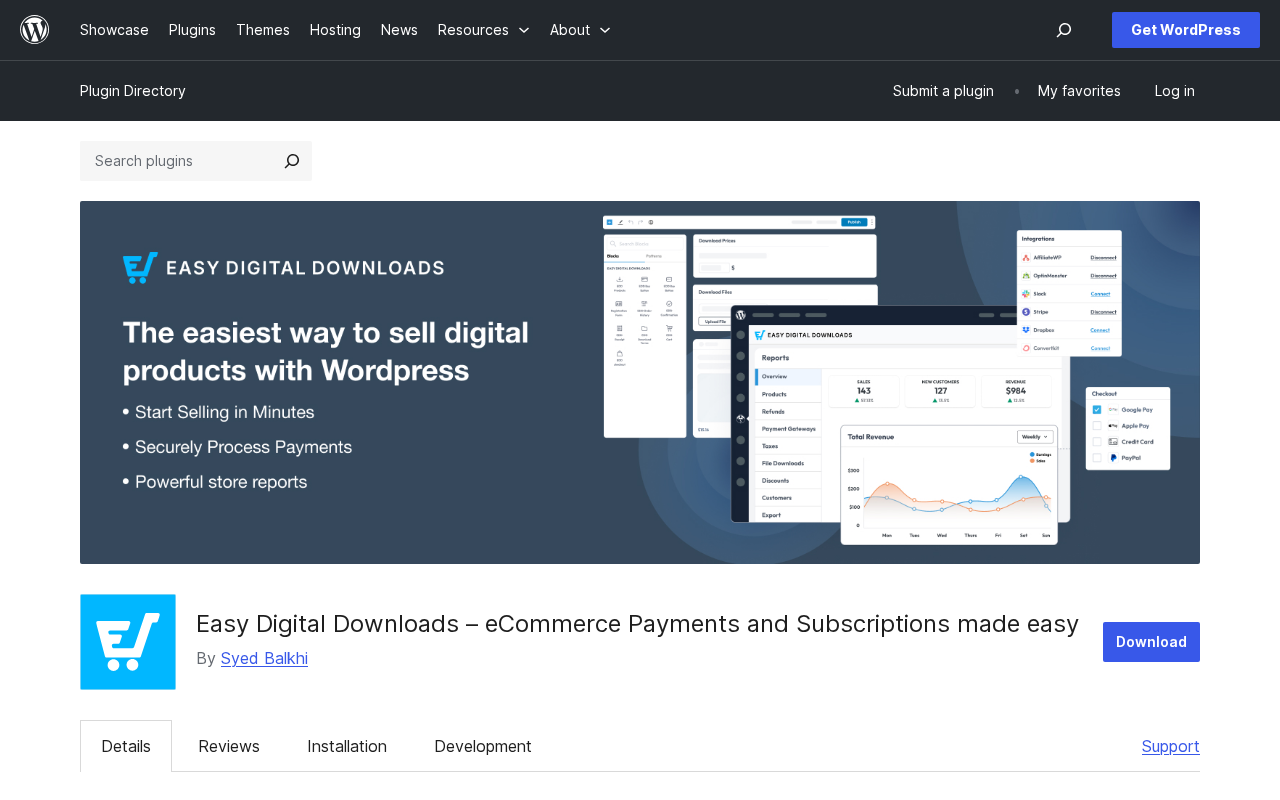
Easy Digital Downloads, commonly called EDD, is a self-hosted WordPress ecommerce plugin built exclusively around digital product delivery. It was created by Pippin Williamson in 2012 and released publicly on WordPress.org. The plugin grew into one of the most-used platforms for digital creators on WordPress through a straightforward approach: everything in the plugin existed to help you sell a file.
Today EDD is part of Awesome Motive, the company behind WPBeginner, WPForms, OptinMonster, and MonsterInsights. Syed Balkhi, Awesome Motive’s founder, serves as CEO. Chris Klosowski leads EDD day-to-day as president and has been part of the EDD team since 2012. The core plugin remains free and open-source on WordPress.org; Awesome Motive manages the commercial side (Pro plans and extensions) at easydigitaldownloads.com. Restrict Content Pro, a membership plugin that predated the Awesome Motive acquisition, is now integrated into EDD Pro plans as the content restriction feature.
The plugin integrates with WordPress at the post type level. Each digital product is a custom post type called a “download.” Products appear in the WordPress admin under a “Downloads” menu item, behave like WordPress posts (title, description, featured image, categories, tags), and hook into the block editor for checkout forms and product displays.
Unlike WooCommerce, EDD does not build shipping, tax rates for physical goods, or inventory management for tangible items into its core design. That deliberate narrowness is its defining characteristic. A seller who only sells digital files gets a leaner, more focused admin experience without features that do not apply to their business.
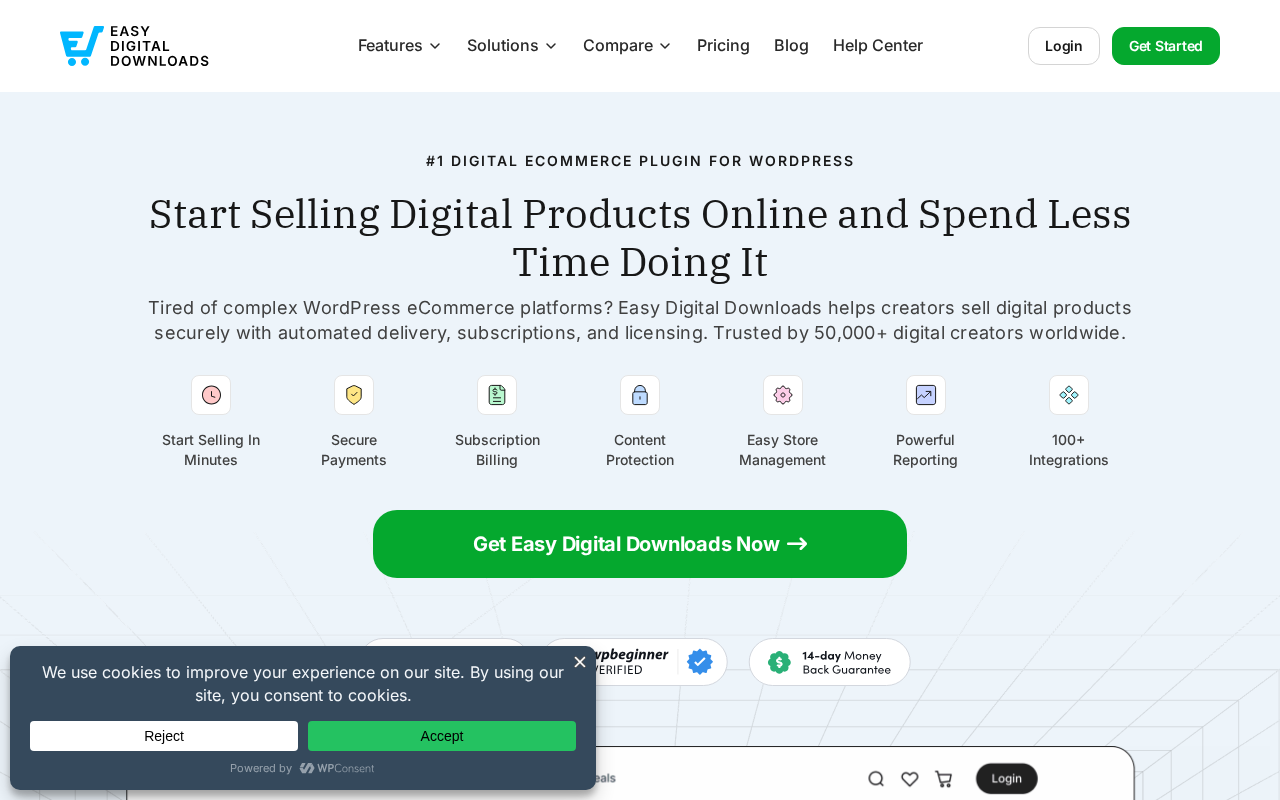
Who EDD is best for
Strong fit:
- Ebook and PDF sellers. If your entire catalog is downloadable files, EDD’s focused architecture removes every feature you do not need. Product setup is direct: title, file upload, price, publish. No shipping zones, no variant weight fields, no physical inventory.
- WordPress plugin and theme developers. EDD built the original software licensing model for WordPress-adjacent software. The Professional plan includes the Software Licensing extension, which handles license key generation, activation limits, site verification, and automatic plugin update delivery from your own server.
- Course creators selling digital access. The Extended plan adds Content Restriction, which lets you lock WordPress content behind purchases. Customers buy access rather than downloading a file. This covers simple membership and gated content use cases without a dedicated membership plugin.
- Digital artists, photographers, and musicians. Any creator selling files (PSDs, hi-res images, audio tracks, video files) gets a clean storefront and automated delivery without needing to understand WooCommerce’s physical-product logic.
- Early-stage digital sellers testing a product. The free Lite tier includes the full storefront, unlimited products, and working payment processing via Stripe and PayPal. You can go live, make real sales, and evaluate revenue before spending anything on Pro features.
- Developers building client stores for digital products. EDD’s hook system and REST API are well-documented. The plugin has been extended by third-party developers for over a decade, which means the ecosystem is mature and the architecture is predictable.
Weaker fit:
- Primarily physical goods sellers. EDD does support physical product shipping (available on the Professional plan), but it is not the core design target. WooCommerce or SureCart will give you a more complete physical goods experience.
- Sellers who need deep subscription management from day one and want to minimize costs. Subscriptions require at least the Personal plan at $99.50 per year (introductory, $199 at renewal). SureCart includes subscriptions on its free plan, which changes the comparison for subscription-first businesses.
- Sellers who need a wide variety of payment gateways beyond Stripe and PayPal. The core free tier covers the major processors. Authorize.net and 2Checkout require the Extended plan or higher. ClickBank requires a paid plan.
- Teams that want a managed, hosted solution. EDD is self-hosted. You supply the WordPress hosting, manage updates, and handle any plugin conflicts that arise.
Installation and setup
I installed and activated EDD v3.6.9 on a fresh local WordPress 7.0.2 instance. The plugin appeared in the Plugins list, and I activated it with one click. WordPress immediately redirected to the EDD onboarding wizard, confirming that the first-activation wizard trigger works as documented.
The setup wizard is short and direct. It collects three things:
- Business type. You describe what you sell: digital products, physical products, software/apps, services, or a combination. This selection adjusts the onboarding recommendations that follow.
- Payment method. Stripe is presented as the default and recommended option. PayPal and other supported processors are available. Stripe connects via OAuth, so setup is a few clicks without pasting API keys.
- Store pages. EDD creates the required store pages (checkout page, success page, failure page, purchase history page) automatically. The wizard assigns them and confirms the configuration.
I completed all four wizard steps in a few minutes on a fresh install. After finishing, WordPress loaded the admin dashboard with a “Downloads” sidebar menu covering Products, Orders, Customers, Reports, and the EDD Settings panel. I confirmed all of these sections load and display correctly. I also confirmed the wizard-generated store pages work on the frontend: the checkout page loaded at /checkout/ and the purchase history page loaded at /purchase-history/.
Adding the first product. From Downloads > Add New, the product editor opens. It uses the WordPress block editor with EDD’s custom panel in the sidebar. The title goes at the top, the content area holds the product description, and the product-specific configuration lives in the “Download Files” and “Download Prices” sections.
In Download Files, you upload or link the files that buyers receive after purchase. EDD handles secure storage and time-limited download links automatically, so buyers cannot share a direct download URL that bypasses the purchase flow.
In Download Prices, you set either a single price or enable variable pricing. Variable pricing lets you offer multiple tiers (Bronze, Silver, Gold) or product variants (different file formats, license types) from one product listing, each with its own price and files.
I created and saved a sample Download product (“Sample eBook: Quick Start Guide”) with a $9.99 price and a PDF file attachment, and it appeared in the Downloads list with Published status immediately after saving.
The storefront and checkout blocks
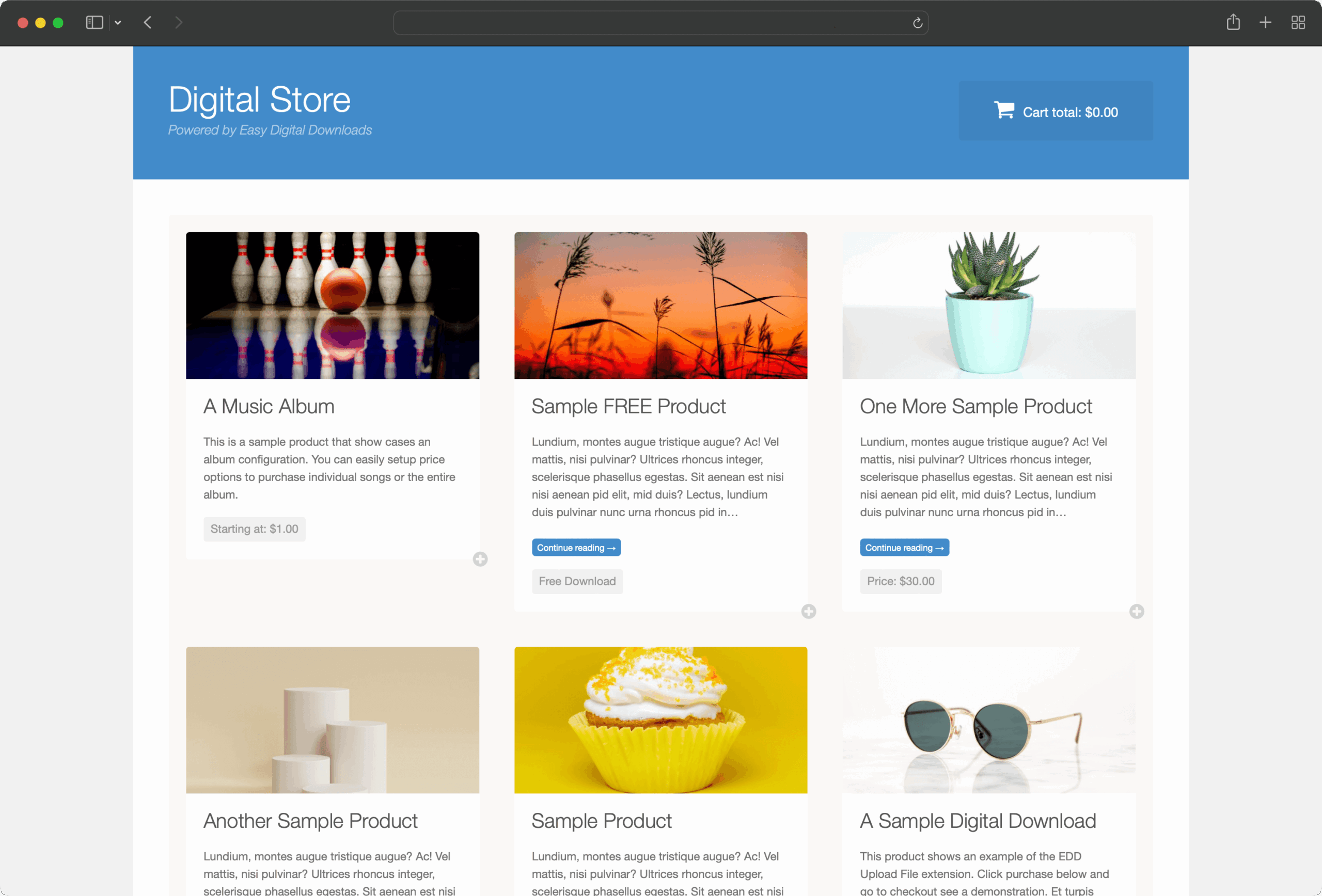
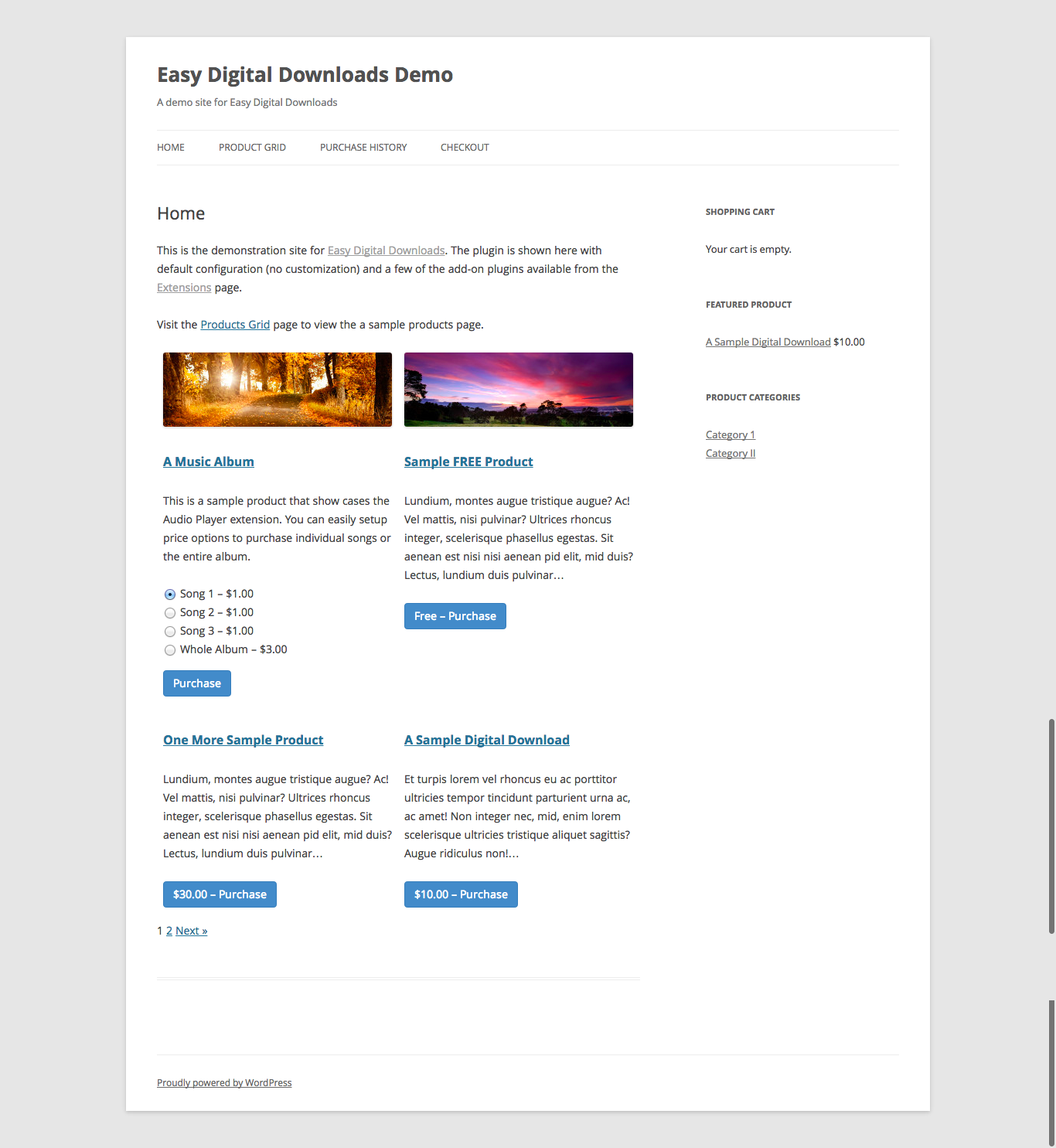
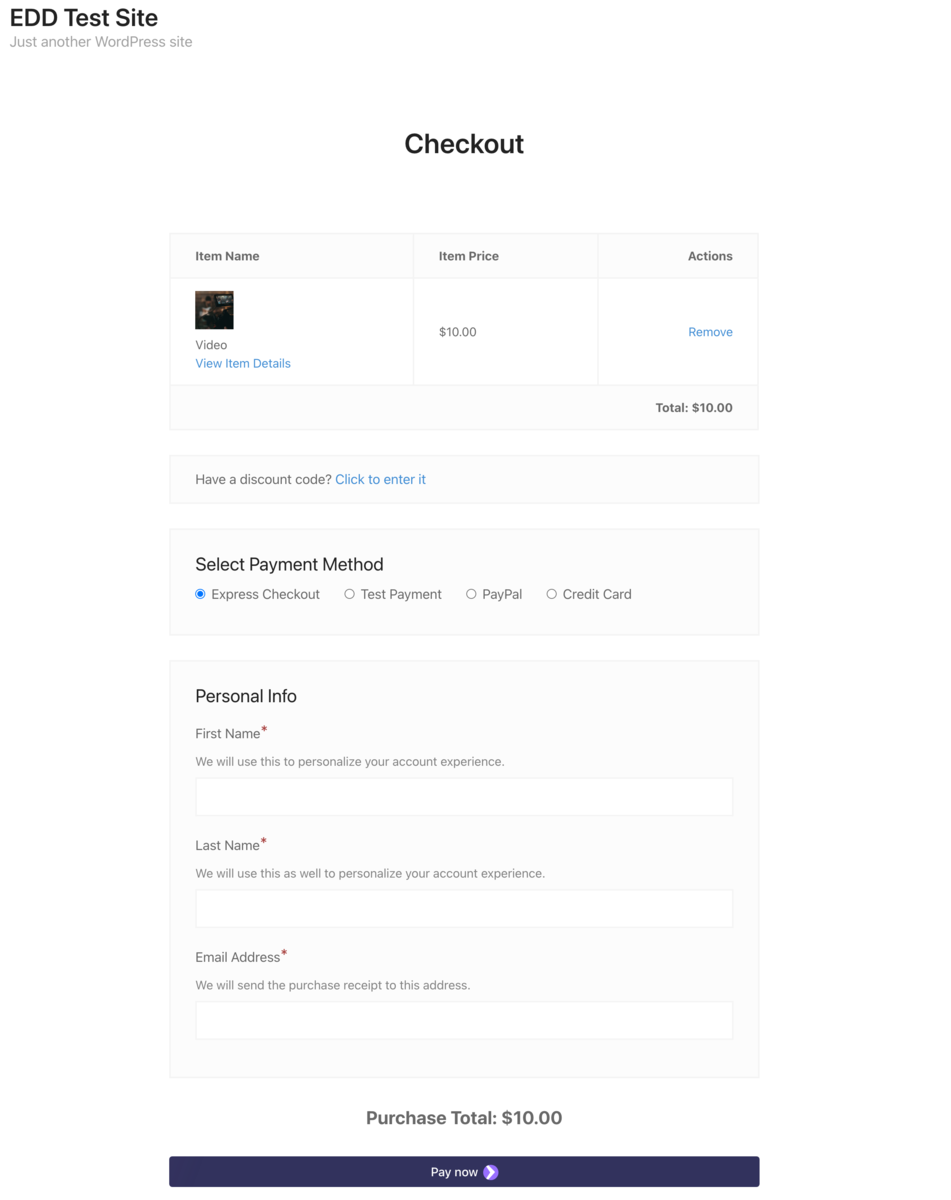
EDD ships with native WordPress blocks for displaying products and handling checkout. The product display blocks render a grid of downloads with images, prices, and add-to-cart buttons. The checkout block renders a complete purchase form within a WordPress page.
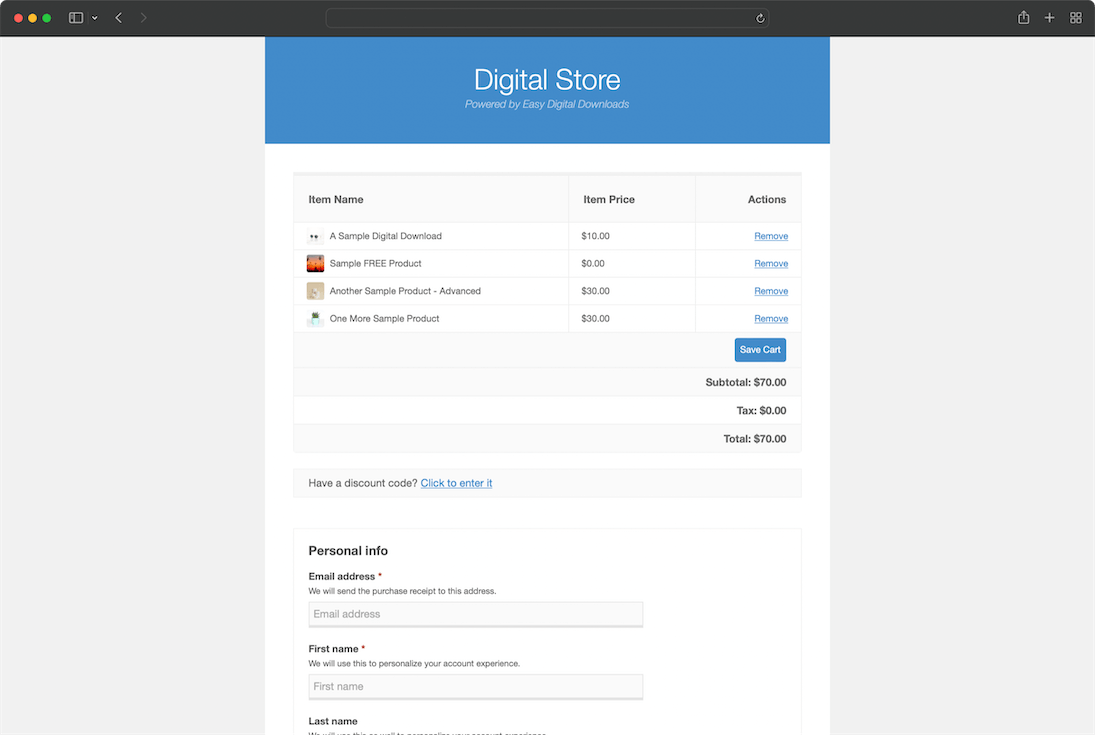
The checkout block includes:
- Customer email and name fields
- Billing address collection (configurable)
- Payment method selection (based on configured gateways)
- Coupon code input
- Order summary with itemized products
- Express checkout buttons (Apple Pay, Google Pay via Stripe)
The blocks render cleanly on the Twenty Twenty-Five and other standard WordPress themes. The vendor also highlights Vendd, a commercial theme built specifically for EDD stores, which adds more polished product grid and checkout styling.
After a completed purchase, EDD sends an automated email receipt to the buyer and an order notification to the store admin. The receipt includes a secure download link that expires after a configurable number of hours or download attempts.
Payments and gateways
EDD’s payment gateway ecosystem is one of its strongest points. The plugin is a verified partner of Stripe, PayPal, and Square. That partnership status means EDD meets each processor’s integration quality standards, which matters for payment reliability and feature availability.
I confirmed in the sandbox that the Gateways settings page lists Stripe, PayPal, Square, and Test Mode as available gateways on the free tier. Connecting a live gateway requires OAuth for Stripe and PayPal, or API keys for Square and others.
With Stripe connected, buyers can pay with:
- Credit and debit cards
- Apple Pay and Google Pay
- WeChat Pay, AliPay, Amazon Pay, GrabPay
- Bancontact, EPS, giropay, iDEAL
- Klarna
- Przelewy24
- BLIK (added in v3.6.8)
- Link by Stripe (saved card checkout)
- CashApp
PayPal adds PayPal standard, PayPal Credit, and Venmo. The most recent EDD version (3.6.9) added support for PayPal Fastlane, which allows returning PayPal customers to complete purchases with one click without re-entering payment details.
EDD does not charge a platform transaction fee. You pay only what Stripe, PayPal, or your chosen processor charges. For Stripe, that is typically 2.9% plus $0.30 per domestic card transaction in the US (Stripe’s standard rate).
Authorize.net and 2Checkout (Verifone) are available on Extended plans and above. ClickBank is available on paid plans.
Subscriptions and recurring revenue (paid feature)
Recurring payments in EDD require at least the Personal plan ($99.50 per year introductory, $199 at renewal). The Subscriptions feature is not available in the free Lite tier.
When enabled, subscriptions let you set any product to bill on a recurring schedule: weekly, monthly, quarterly, or annually. You can configure:
- Free trials (flat period before first charge)
- Signup fees (one-time upfront charge added to the first subscription payment)
- Grace periods (buffer time before a failed subscription is suspended)
- Subscriber self-management via the customer account area (cancel, update card)
Dunning for failed payments relies on the behavior of your payment gateway. Stripe’s Smart Retries handle automatic reattempt logic for failed cards. EDD sends email notifications to subscribers when a payment fails and provides a link for the customer to update their payment method.
What EDD subscriptions does not include natively: a dedicated retention flow (no pause or downgrade offer before cancellation), proration on plan changes, or tiered billing per seat. For stores whose entire business model depends on optimizing subscription retention, SureCart’s built-in Subscription Saver and dunning tools offer a more complete set of retention controls in one place.
Software licensing (Professional plan)
Software licensing is the feature that EDD is most distinctively associated with. For WordPress plugin and theme developers who want to sell their software and manage licenses from their own site, EDD’s Software Licensing extension (included in the Professional plan at $299.50 per year introductory) is one of the most mature solutions available.
The extension handles:
- License key generation. Each purchase generates a unique license key delivered automatically in the order receipt.
- Activation limits. You set how many sites or devices each license may be activated on. Customers activate their license inside your plugin’s settings panel.
- Site verification. Your software checks in with your EDD store to verify the license is active. This remote verification is what allows you to restrict access to updates or features for expired licenses.
- Automatic update delivery. EDD can serve as the update source for your plugin. Customers with valid licenses receive update notifications and can install updates directly from their WordPress admin, exactly as they would with a free plugin from WordPress.org.
- License renewal management. Customers receive renewal reminders before their license expires. They can renew from the customer account area.
For WordPress developers, this is a self-hosted alternative to licensing through a marketplace like Envato. The trade-off is that you own the whole flow (payment, delivery, verification) rather than relying on a third-party marketplace, but you also take on the support and maintenance responsibility.
Content restriction (Extended plan and above)
Content Restriction, included from the Extended plan ($199.50 per year introductory), lets you gate any WordPress content behind an EDD purchase. This covers:
- Individual posts and pages restricted to buyers
- Post categories or tags that require purchase to access
- Custom post types (useful for locking course lessons, documentation, or community posts)
When a non-customer visits a restricted page, they see a configurable message or are redirected to the purchase page. After a successful purchase, access is granted automatically and persists for the license period.
This is EDD’s closest equivalent to a membership or access control system. It is a focused implementation rather than a full membership platform: it does not handle member tiers, content drip scheduling, or community features natively. For more complex membership requirements, a dedicated membership plugin such as MemberPress would offer deeper configuration.
Abandoned cart recovery (Personal plan and above)
Abandoned cart recovery is included from the Personal plan. When a customer begins checkout, enters their email, and then leaves without completing the purchase, EDD captures the session. A configurable sequence of follow-up emails goes out automatically.
The recovery sequence lets you set timing for each email in the sequence, customize subject lines and body text, and optionally include a discount code in recovery emails to incentivize completion. No third-party email service is required for the basic recovery flow; EDD sends recovery emails through WordPress’s mail system or a connected transactional email service.
Cart abandonment data appears in the EDD analytics dashboard, showing recovery rate alongside revenue attributed to recovered carts.
Analytics and reporting
EDD’s reporting section covers the core metrics a digital store needs. I verified in the sandbox that the Reports dashboard loads correctly on a fresh install, showing chart areas, date range selectors, and empty-state placeholders for revenue, sales, and customer counts.
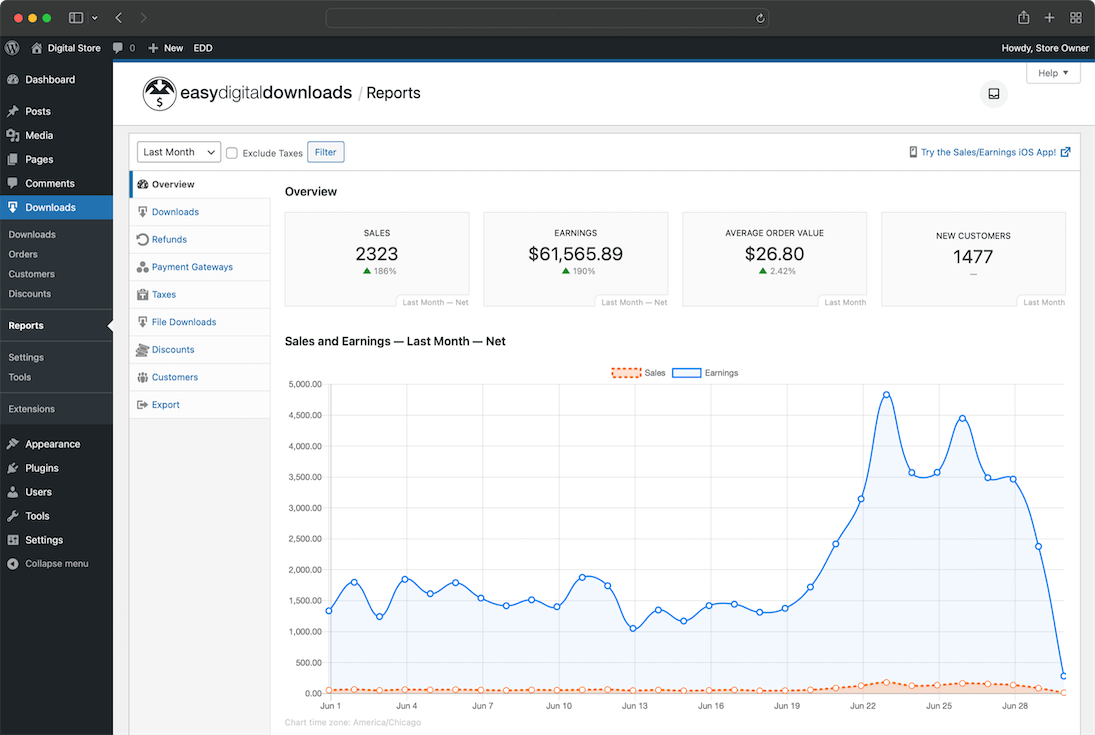
- Revenue over time (chart with configurable date range)
- Sales count and average order value
- Top-selling products
- Revenue by payment gateway
- Tax collected
- Refunds issued
- Customer acquisition count
The customer management section shows each buyer’s purchase history, lifetime value, email address, and account status. The Customers list and Orders list both loaded cleanly in the sandbox, confirming the admin navigation works on a fresh install.
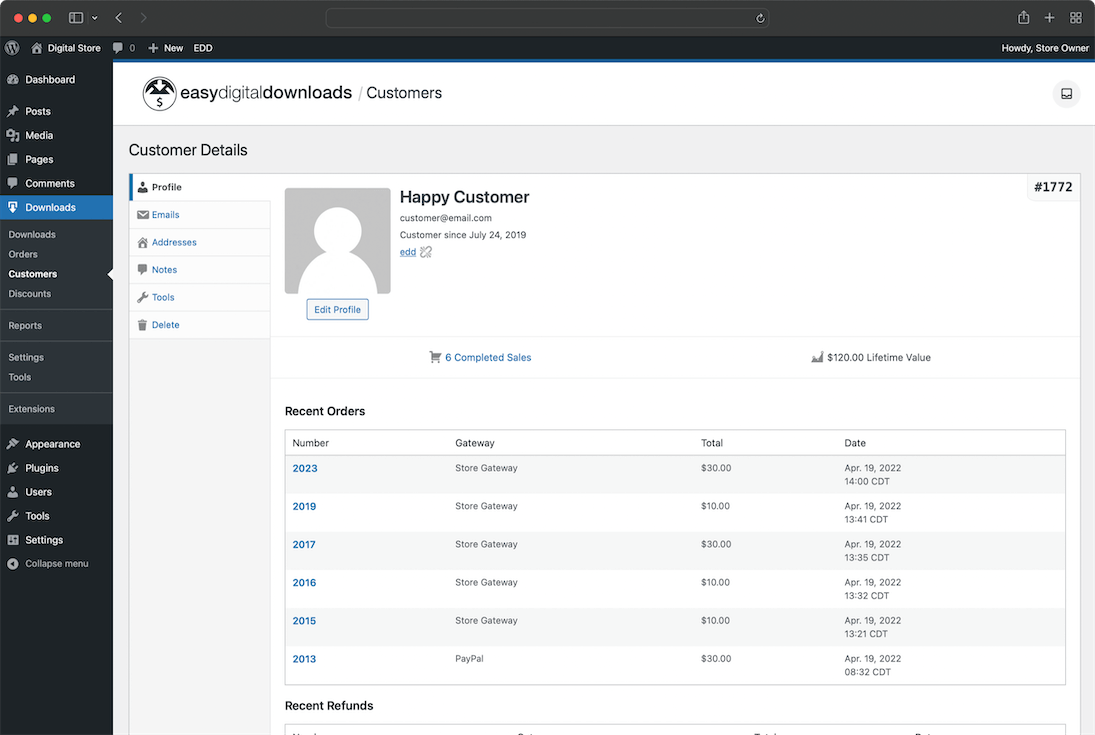
Orders appear in the payment history with status filters (completed, pending, refunded, failed, abandoned).
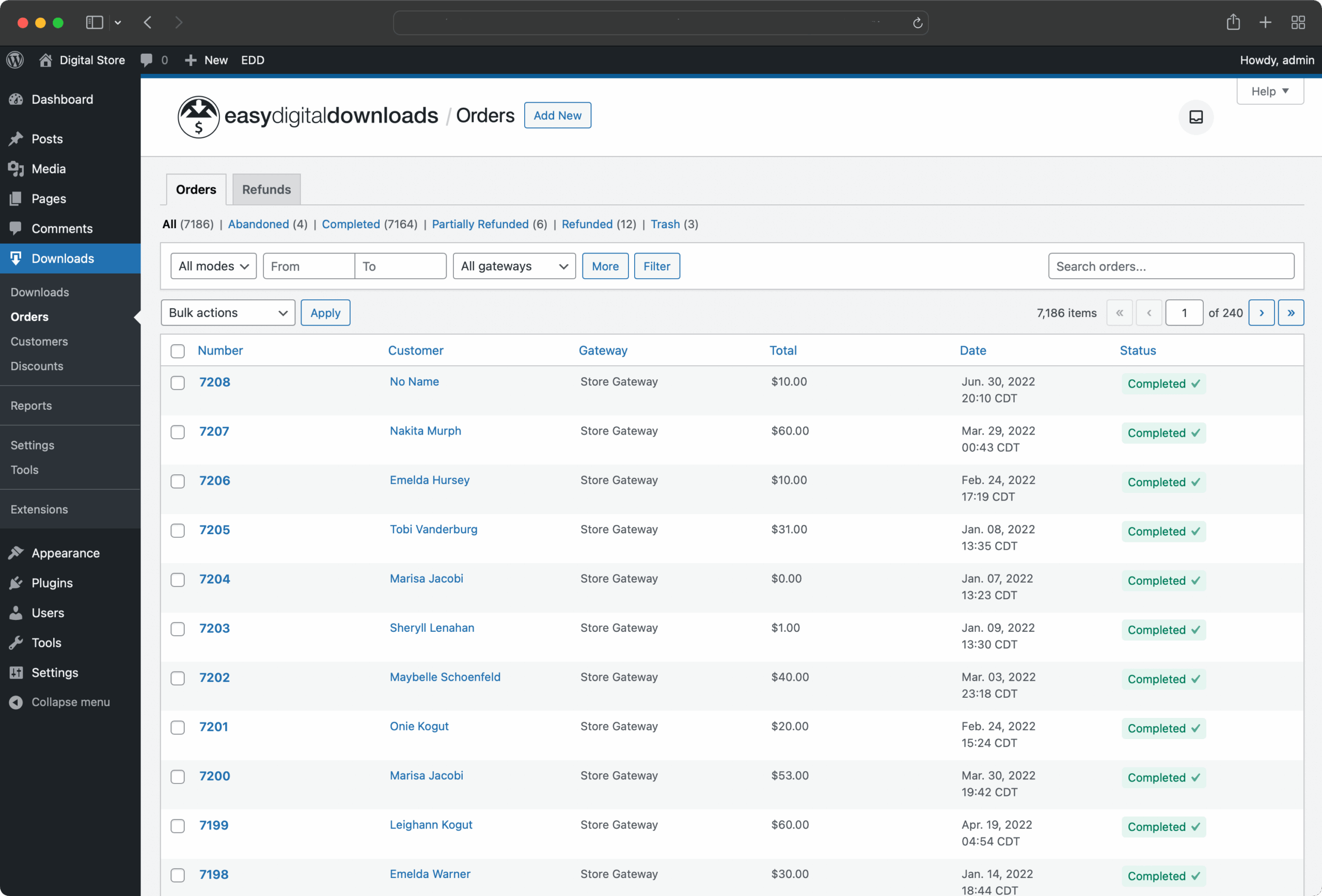
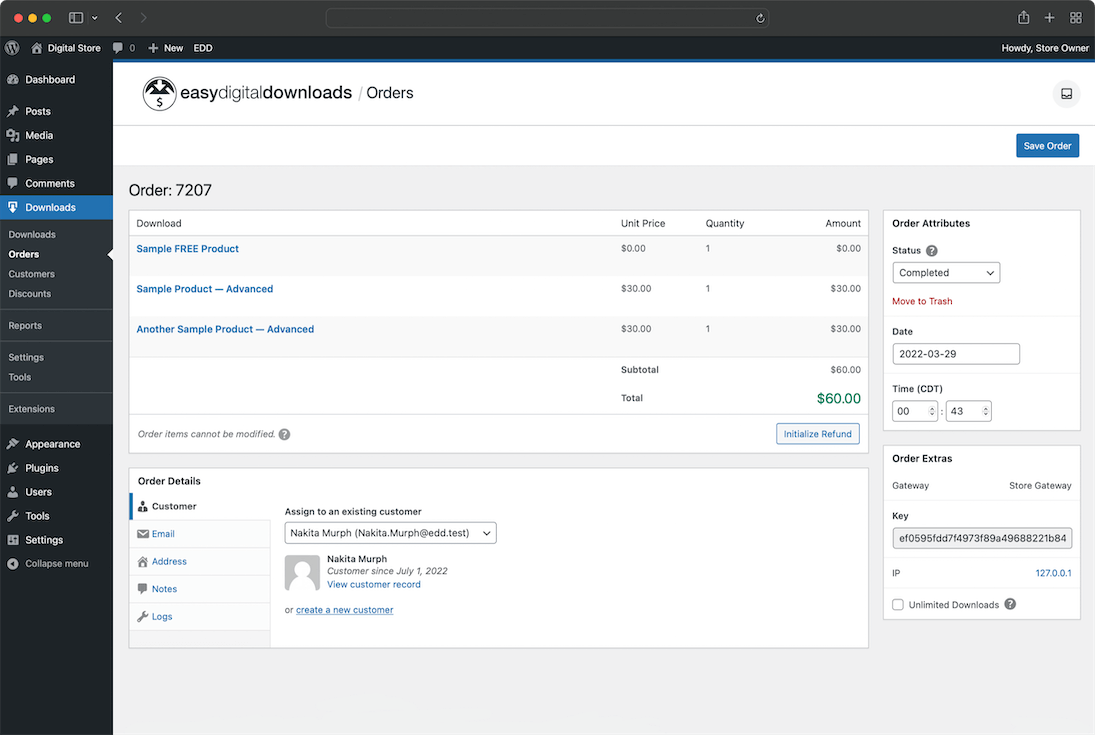
Each order has a detail view showing itemized products, the payment gateway used, customer details, file download logs (how many times each file was accessed), and the license key if software licensing is active.
The All Access plan unlocks Advanced Reports, which adds deeper breakdowns and exportable reporting data.
Extensions and integrations
EDD’s extension ecosystem at easydigitaldownloads.com contains over 100 official integrations. Categories include:
| Category | Examples |
|---|---|
| Email marketing | Mailchimp, ConvertKit, ActiveCampaign, AWeber, Campaign Monitor, GetResponse, MailPoet |
| Analytics and tracking | Google Analytics, Campaign Tracker |
| CRM and automation | Zapier (Extended plan+), ActiveCampaign |
| Accounting | FreshBooks, QuickBooks |
| File hosting | Amazon S3, Dropbox |
| Product marketing | Cross-sells/upsells, recommended products, customer wish lists |
| Commerce tools | Product bundles, variable pricing switcher, custom prices, purchase limits, bulk discount codes |
| Developer tools | Git Download Updater (serve software updates from Git), frontend submissions (marketplace model) |
The Zapier integration (Extended plan and above) opens connections to practically every external tool through Zapier’s automation layer, covering scenarios EDD does not handle natively.
Third-party developers have also produced EDD-compatible themes, extensions, and tools over the past 13 years. The maturity of the ecosystem is a genuine advantage: edge cases that would require custom development on a newer platform often have a ready-made EDD extension available.
Pricing
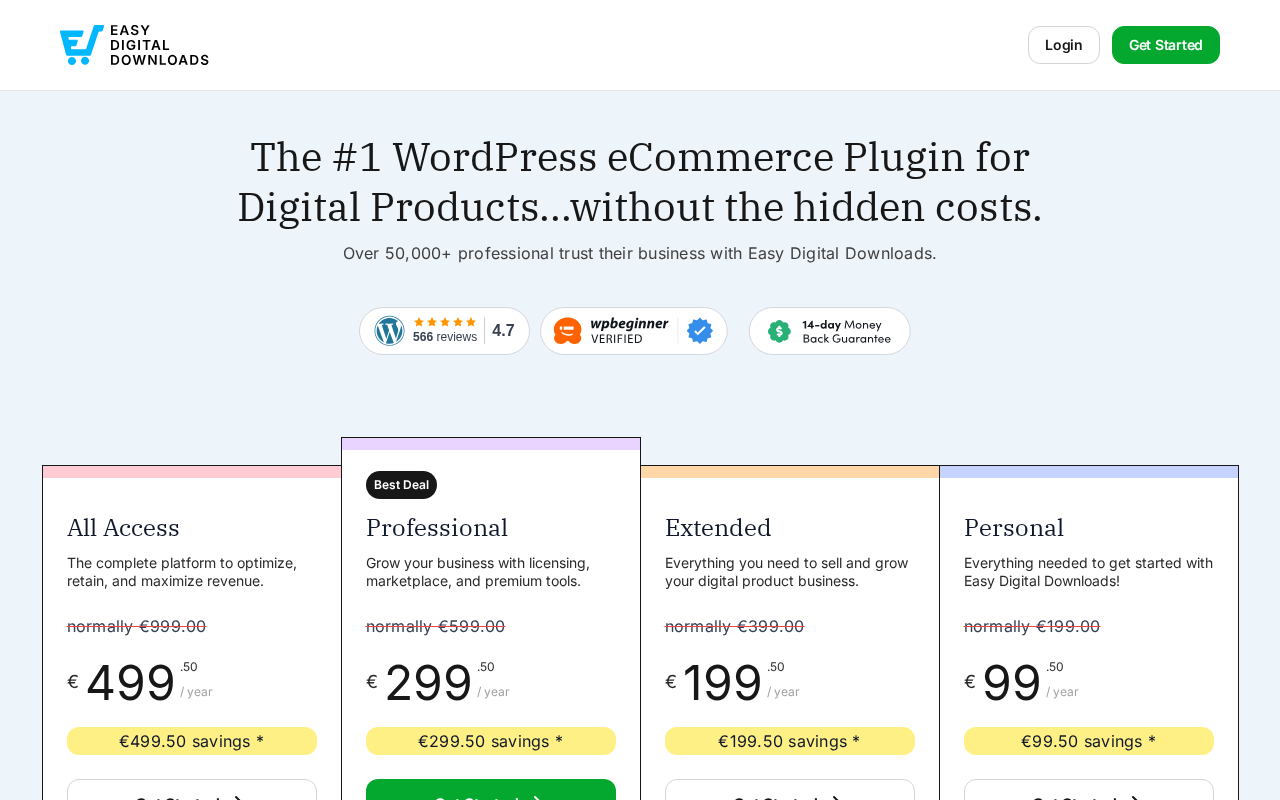
EDD uses an introductory pricing model where the first year is discounted significantly and renewals run at the standard rate. This is worth understanding carefully before choosing a plan.
Lite (free)
Available from WordPress.org at no cost. Includes:
- Unlimited products
- Unlimited transactions
- Full checkout and cart
- Stripe and PayPal integration (basic)
- Square
- Check payments
- Customer management
- Basic reports and revenue tracking
- Full data ownership (no SaaS lock-in, runs on your server)
Notably absent from the free tier: subscriptions, abandoned cart recovery, EU VAT compliance, AI recommendations, and software licensing.
Personal ($99.50 per year introductory; $199 at renewal) – 1 site
Everything in Lite plus:
- Subscriptions and free trials
- Stripe Pro (Apple Pay, more Stripe methods)
- Custom discount codes
- EU VAT compliance
- AI-powered product recommendations
- Abandoned cart recovery
- Revenue reporting
- Standard support
Extended ($199.50 per year introductory; $399 at renewal) – 1 site
Everything in Personal plus:
- Authorize.net and 2Checkout/Verifone
- Multi-currency support
- Content restriction for gated content
- Product bundles
- Customer reviews
- Zapier integration
- Conditional success redirects
- Customer wish lists
Professional ($299.50 per year introductory; $599 at renewal) – 2 sites
Everything in Extended plus:
- Software licensing and API (the defining feature of this tier)
- Multi-vendor marketplace and frontend submissions
- Commissions and payouts
- Recommended products
- Physical product shipping support
- Post-purchase funnels
- Premium support
- 2-site license
All Access ($499.50 per year introductory; $999 at renewal) – 3 sites
Everything in Professional plus:
- Customer loyalty and rewards
- Fraud prevention
- Advanced reports and exports
- Bulk discount code generation
- Product comparisons
- Direct customer messaging
- 3-site license
The renewal price matters. At introductory pricing, the Personal plan appears to be a straightforward $99.50 decision. At the $199 renewal price, you are paying $199 per year for subscriptions, abandoned cart recovery, and EU VAT on one site. That is a real cost to carry in your annual budget.
A 14-day money-back guarantee applies to all paid plans.
Pros and cons
Pros
- Free Lite tier is genuinely complete for a basic digital product store: unlimited products, transactions, and real payment processing with no platform fees.
- 13-plus years of active development. EDD is one of the most battle-tested digital ecommerce solutions on WordPress.
- No platform transaction fees on any plan. You pay only what your payment gateway charges.
- Stripe integration is one of the deepest available, covering 15-plus payment methods including Apple Pay, Google Pay, BLIK, iDEAL, Klarna, and more.
- Software licensing (Professional plan) is the most mature WordPress-native solution for plugin and theme developers who want to sell and license their software independently.
- Setup wizard triggers automatically on activation and guides you through business type, payment, and store page configuration in a few minutes.
- Product management is clean and intuitive for digital-only catalogs. No shipping field bloat, no physical variant logic.
- Native WordPress blocks for product grid and checkout. Works with standard block themes and the Twenty Twenty-Five theme out of the box.
- Download security is handled automatically: time-limited links, download attempt limits, access logs per order.
- Customer account area lets buyers re-download files and manage subscriptions without contacting support.
- All data stays on your server. No third-party cloud backend, no account dependency, no vendor lock-in beyond the plugin itself.
- Mature extension ecosystem with 100-plus official integrations and a large third-party developer community.
- 40,000-plus active installs and 50,000-plus reported stores across 187 countries.
- 4.7/5 rating (588 reviews on WordPress.org); 535 five-star ratings reflect a consistently satisfied majority.
- 14-day money-back guarantee on all paid plans.
Cons
- Introductory pricing is not the ongoing cost. All paid plan prices roughly double at renewal. A store budgeting based on first-year pricing will face a significantly higher renewal bill.
- Subscriptions require the Personal plan (minimum $99.50/yr intro, $199/yr renewal). SureCart includes subscriptions in its free tier, which makes EDD less competitive for subscription-first stores that want to minimize fixed costs.
- Software licensing, the feature most uniquely associated with EDD, is locked behind the Professional plan ($299.50/yr intro, $599/yr renewal). For a solo developer selling one plugin, that is a significant annual commitment.
- Content restriction is a mid-tier feature (Extended plan, $199.50/yr intro). Basic membership gating costs more here than on alternatives that bundle it at a lower entry point.
- The free Lite tier has no subscriptions, no abandoned cart recovery, no EU VAT compliance, and no multi-currency. Competing free tiers (SureCart in particular) offer several of these at no cost.
- No dedicated subscription retention flows. There is no built-in “pause” or “downgrade before cancel” step when a subscriber tries to cancel.
- 34 one-star reviews out of 588 (WordPress.org) reflect a persistent minority of dissatisfied users. Common themes: support response times on lower tiers, confusion around the renewal pricing model, and extension compatibility issues after major updates.
- Physical goods support exists (Professional plan) but is not a primary design target. WooCommerce handles complex physical inventory, shipping carriers, and tax jurisdictions more thoroughly.
- Hosting costs are not included. You supply your own WordPress hosting, which is an additional expense not visible in the EDD plan pricing.
Alternatives to Easy Digital Downloads
WooCommerce. The most widely deployed WordPress ecommerce plugin, with 7-plus million active installs. Choose WooCommerce if you need a deep physical product feature set, a vast extension marketplace, or enterprise-scale order management. EDD is simpler and more focused for pure digital stores; WooCommerce is broader and better for mixed physical and digital catalogs.
SureCart. A newer WordPress ecommerce plugin with a cloud-hosted backend. SureCart includes subscriptions, order bumps, cart abandonment recovery, affiliate management, and license key delivery at no extra cost on its free plan. The trade-off is that order data lives on SureCart’s servers rather than your WordPress database. For subscription-first or digital-software businesses that want to start without upfront plan costs, SureCart is the strongest direct comparison.
Lemon Squeezy. A fully hosted platform for digital products and software. Not a WordPress plugin, but relevant if you want a managed merchant-of-record service where Lemon Squeezy handles tax compliance and chargebacks globally. The trade-off is a per-transaction fee (5% plus $0.50 per transaction) and platform lock-in versus EDD’s self-hosted model.
Gumroad. A hosted digital marketplace with a simple product listing model. Gumroad charges no monthly fee; pricing is 10% plus $0.50 per transaction for direct sales through your own links, and 30% per transaction when buyers discover and purchase through Gumroad’s Discover marketplace. Gumroad also acts as merchant of record, handling sales tax and VAT compliance worldwide at no additional charge. EDD charges no platform transaction fee on any plan, making EDD more cost-efficient for sellers who already have their own audience and traffic. Gumroad’s advantage is built-in discoverability and hands-off tax compliance; EDD’s advantage is zero platform cut for established sellers.
MemberPress. A dedicated WordPress membership plugin. Choose MemberPress if your product is primarily access control and membership management rather than file delivery. MemberPress has deeper membership-specific features (content drip, community, course completion tracking) that EDD’s content restriction does not replicate.
WP Simple Pay. A Stripe-focused payment form plugin for WordPress. Choose WP Simple Pay if you need flexible payment forms and subscriptions but not a full storefront, product catalog, or download delivery system.
Final verdict
Easy Digital Downloads earns its position as the default recommendation for digital product sellers on WordPress through focus and longevity, not through feature breadth. It does fewer things than WooCommerce, but it does the things that matter most for digital sellers with fewer rough edges.
The free Lite tier is a practical starting point. I completed the four-step setup wizard, created and saved a sample Download product with a title, price, and file attachment, and confirmed the generated store pages work on the frontend. The activation flow, wizard, product editor, and core admin navigation all worked correctly on a fresh install. You can publish a product, connect Stripe, and take a real payment without touching a credit card. That low barrier to entry is valuable for creators testing their first digital product before committing to ongoing platform costs.
The paid plans tell a more complicated story. The introductory pricing is competitive. The renewal pricing is not, particularly at the Professional tier where software licensing becomes available at $599 per year. Plugin and theme developers evaluating EDD for software licensing should budget for the renewal price from the start, not the first-year discount.
The comparison that matters most in 2026 is EDD versus SureCart. SureCart’s free tier now includes subscriptions, cart abandonment recovery, and digital file delivery at zero cost. EDD’s free tier does not. For sellers who need subscriptions from day one and want to delay plan costs, SureCart has a structural pricing advantage. For sellers who need software licensing, prefer a fully self-hosted architecture with no external account dependency, or have an established EDD store they do not want to migrate, EDD remains the more mature and better-evidenced choice.
Thirteen years of active development, 50,000-plus stores, and 30 million-plus processed orders are not marketing claims made up for a landing page. They represent real operational history. For digital product sellers who want a proven WordPress-native tool with no cloud lock-in, EDD delivers.
Browse more WordPress plugin reviews in the Reviews section.