


Twenty thousand WordPress sites use Ecwid to power an online store. That number puts it well behind WooCommerce’s seven million installs, but Ecwid is not trying to be WooCommerce. Where WooCommerce installs a complete ecommerce engine into your WordPress database, Ecwid rents you a store from the cloud and embeds a window to it inside your WordPress site.
That distinction shapes everything: setup speed, maintenance responsibility, product limits, SEO behavior, and pricing. If you are evaluating Ecwid for a WordPress store, understanding the SaaS architecture first will save you from surprises after signup.
What this review covers and how it was researched. This is a research-based review of Ecwid Ecommerce Shopping Cart version 7.0.9, updated August 8, 2026. I reviewed the official Ecwid website, pricing and feature pages, the WordPress.org plugin listing (20,000-plus active installs, 4.5 out of 5 stars from 228 reviews), the official plugin changelog, user reviews on WordPress.org and Trustpilot, and Ecwid’s own published comparison materials. I walked through the Ecwid account creation and onboarding flow to document the setup experience firsthand. Pricing figures are from Ecwid’s pricing page as of September 2026 and should be verified before purchase.
At a glance:
- Reviewed version: 7.0.9, updated August 8, 2026
- Active installs: 20,000+ (WordPress.org)
- Rating: 4.5 out of 5 (228 reviews on WordPress.org)
- Starting price: $5/month
- No permanent free plan (free trial available)
- Bottom line: a genuinely fast-to-launch SaaS store for WordPress, with product limits, SEO trade-offs, and a billing history that make it a better fit for small, multi-channel sellers than for content-first or high-volume stores
Quick verdict
Ecwid’s strongest case is speed and simplicity. You can have a working store embedded in your WordPress site in under an hour, with payments, shipping, and tax configured, with no hosting decisions, plugin conflicts, or security patches to manage. For a small business already running a WordPress site that wants to add ecommerce without rebuilding anything, Ecwid is one of the least painful routes available.
The trade-offs are real. Product limits by plan are strict: 10 products on Starter, 100 on Venture. Your store data lives on Ecwid’s servers, not your own. SEO performance for product pages has historically lagged self-hosted solutions, though version 7.0 improved URL structure. Trustpilot reviews flag price increases as a recurring pain point. And for stores that grow past a few hundred products, the Unlimited plan at $119 per month (annual) begins to look expensive against a self-hosted WooCommerce stack.
Quick verdict summary:
- Best for: small businesses adding ecommerce to an existing WordPress site; multi-channel sellers who need Facebook, Instagram, and marketplace sync without a plugin stack; anyone who wants managed infrastructure over full control.
- Best fit by business type: local shops, artists and creators, service businesses with a small product line, retailers already using Lightspeed POS, and businesses selling across social media and physical locations.
- Standout: zero-maintenance SaaS store, multi-channel selling built in, PCI DSS Level 1 compliance out of the box, one store embeddable across multiple websites.
- Watch out for: product limits by plan, Trustpilot complaints about price increases, SEO limitations compared to self-hosted options, and EU invoice compliance gaps for some merchants.
What Ecwid is
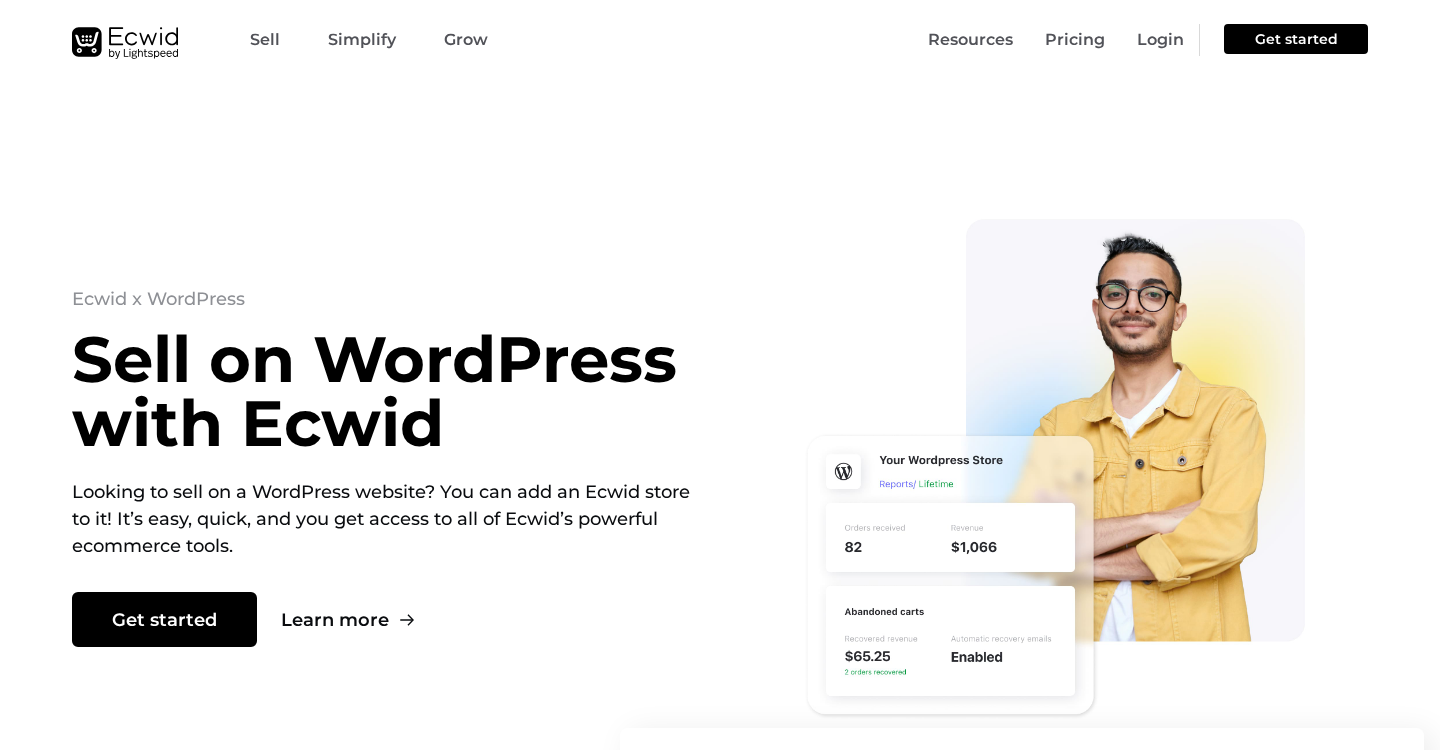
Ecwid (short for “ecommerce widget”) is a SaaS ecommerce platform owned by Lightspeed Commerce since 2021. The WordPress plugin, officially named “Ecwid Ecommerce Shopping Cart,” installs from the WordPress plugin directory and embeds a cloud-hosted Ecwid store into your WordPress site. Version 7.0.9 shipped in August 2026 with WordPress 7.0 compatibility; the plugin has been actively maintained since its initial release.
The key technical distinction: when you install WooCommerce, your products, orders, and customers are stored in your WordPress database. When you install Ecwid, your products, orders, and customers are stored on Ecwid’s servers. The WordPress plugin is a display layer that renders the Ecwid storefront inside your WordPress pages.
This architecture produces real advantages: no plugin conflicts, no WooCommerce update breaking your checkout, PCI DSS Level 1 compliance without additional configuration, automatic security updates, and the ability to embed the same store on multiple websites simultaneously.
It also produces real constraints: you cannot access your store data directly in your WordPress database, product catalog customization works within Ecwid’s interface rather than WordPress’s, and if Ecwid changes its pricing or plan structure, your migration options require data export from a proprietary system.
Ecwid serves sellers in 175 countries across 45 languages. The WordPress.org listing reports 20,000-plus active installs. As of version 7.0, Ecwid introduced SEO-friendly URLs for products and categories, addressing a longstanding complaint about JavaScript-rendered storefronts and auto-generated ID-based URLs.
Who Ecwid is best for
Strong fit:
- WordPress site owners adding a small product catalog. If you run a WordPress site and want to sell 10 to 100 products without learning WooCommerce’s configuration model, Ecwid offers the fastest setup path.
- Multi-channel sellers. Ecwid’s built-in integrations cover Facebook, Instagram, TikTok, Pinterest, Snapchat, Amazon, eBay, and Google Shopping from the Venture plan onward. Equivalent functionality in WooCommerce requires multiple extensions and separate configuration.
- Lightspeed POS users. If you already use Lightspeed Retail for brick-and-mortar sales, Ecwid’s POS integration unifies in-store and online inventory under the same ecosystem.
- Businesses that want managed infrastructure. Ecwid handles security patches, payment compliance, backups, and platform updates. There is no manual WooCommerce security release to apply.
- Sellers who want one store across multiple sites. One Ecwid account embeds into multiple WordPress sites, personal websites, and social pages without managing multiple product databases.
- Subscription and digital product sellers (Venture and above). Digital goods and subscriptions are supported at mid-tier plans without a separate plugin purchase.
Weak fit:
- Large product catalogs on a budget. Ten products on Starter and 100 on Venture are meaningful constraints. A store with seasonal SKUs and size/color variants reaches 100 products quickly.
- Content-first or SEO-focused stores. WooCommerce product pages live natively in the WordPress CMS. Ecwid embeds a widget, and despite improvements in version 7.0, product content is not native WordPress content.
- Merchants who need full data control. Store data lives on Ecwid’s servers. Data residency requirements and migration flexibility are limited compared to self-hosted options.
- EU merchants with specific invoice compliance requirements. Multiple Trustpilot reviews from European merchants cite missing support for Peppol and B2B e-invoice standards required in some EU jurisdictions.
- Large stores at scale. Above 2,500 products, Unlimited at $119 per month annually is the only option. A self-hosted WooCommerce stack on managed hosting can serve similar volume for less total annual spend.
- Teams who want open-source flexibility. Storefront customization happens inside the Ecwid dashboard. Custom checkout flows and deep theme-level integrations are constrained compared to an open-source stack.
Setup and WordPress integration
Installing Ecwid from Plugins > Add New takes under two minutes. Search “Ecwid Ecommerce Shopping Cart,” click Install Now, and activate.
On first activation, the plugin prompts you to create an Ecwid account or log into an existing one. Account creation is free and does not require payment information upfront.
After account connection, the Ecwid panel appears in the WordPress admin sidebar. The setup flow inside the Ecwid admin is separate from the WordPress admin: you open the Ecwid dashboard to add products, configure payments, set up shipping, and customize the storefront design. The WordPress side handles where the store appears on your site.
Adding the store to WordPress pages. The plugin adds a Gutenberg block called “Ecwid Store” that drops the full storefront into any page or post. It also registers a shortcode for classic editor compatibility. The plugin includes 10 dedicated Gutenberg blocks: the full storefront, a product browser, a search bar, a category menu, a cart button, and single-product display embeds. You can combine these with standard WordPress content blocks to build integrated-looking product pages rather than confining the store to a single Shop page.
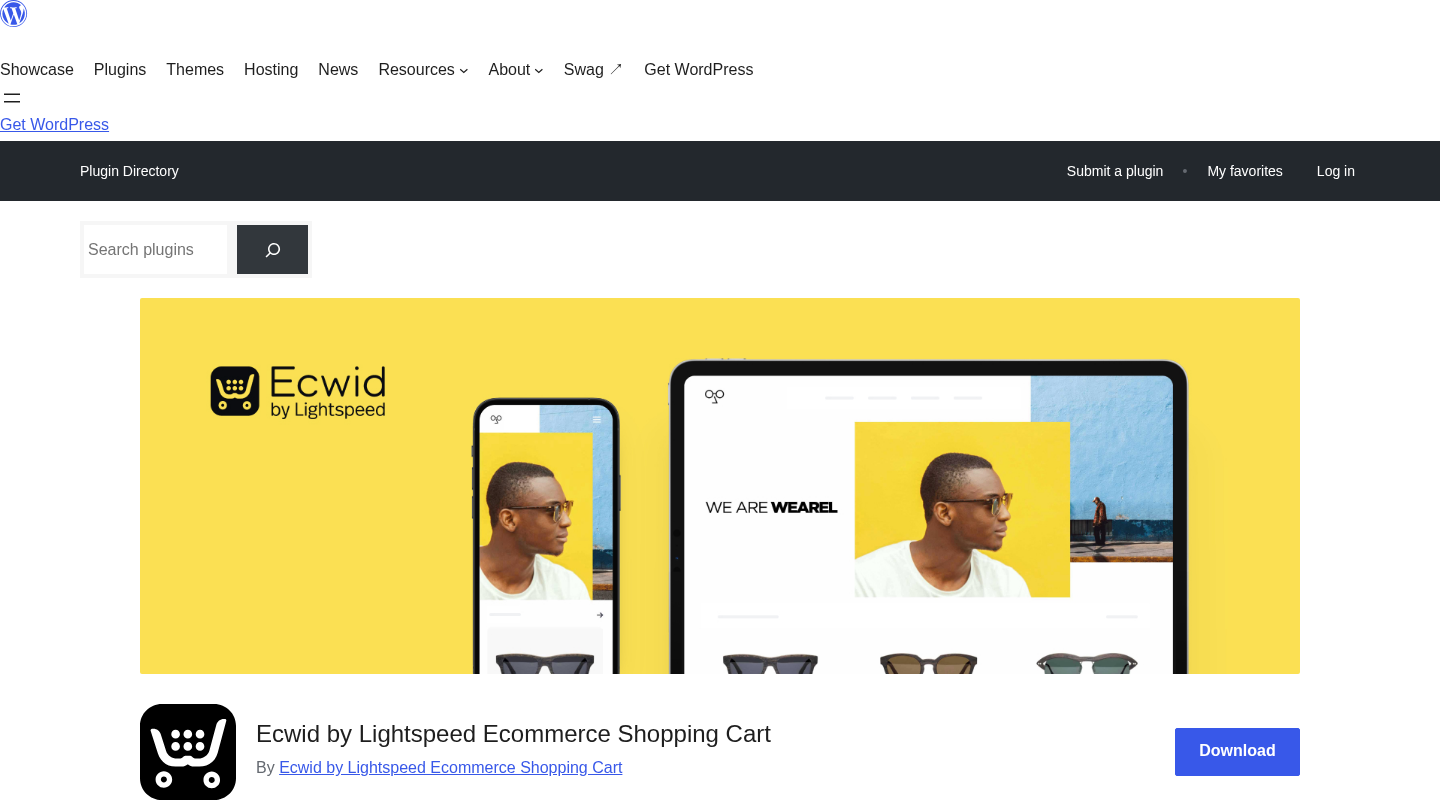
The Ecwid admin dashboard. All product, order, payment, and shipping configuration happens inside the Ecwid dashboard, which opens in the WordPress admin chrome when you click the Ecwid menu item. Product management, analytics, and channel sync settings live here, not in the standard WordPress product editor.
First-time product setup is fast. The product editor asks for a name, description, price, category, images, and stock status. Variable products with multiple sizes or colors use an attribute system similar to WooCommerce, adding options as attribute rows. A basic product can be live in five minutes.
I found the onboarding experience genuinely smoother than WooCommerce’s initial configuration. Ecwid presents a visual checklist covering store information, payment setup, and shipping, and each step is shorter than the equivalent WooCommerce configuration screen. The trade-off is less granular control: Ecwid makes sensible decisions for you at each step, which speeds up setup but constrains options later.
Multi-channel selling
Multi-channel sync is one of Ecwid’s clearest advantages over a default WooCommerce install.
From the Venture plan onward, Ecwid connects your product catalog to:
- Facebook and Instagram (product catalog sync, shoppable posts, ad campaigns)
- TikTok (product catalog and shopping features)
- Pinterest and Snapchat
- Amazon and eBay
- Google Shopping
Inventory syncs automatically across channels. When a product sells on Instagram, it deducts from the same Ecwid inventory that feeds your WordPress store. Setting up Facebook shop sync is a point-and-authorize flow inside the Ecwid dashboard.
WooCommerce can reach these same channels, but each integration requires a separate plugin installation and configuration. Ecwid’s value here is operational simplicity: fewer moving parts, one dashboard, one inventory count.
The multi-channel capability has limits. Marketplace integrations for Amazon and eBay route some merchants through third-party connectors for full listing management, depending on plan and region. Review the channel coverage for your specific market before assuming full native integration.
Payments
Ecwid integrates with more than 70 payment options, including:
- Lightspeed Payments (the native integrated gateway)
- PayPal (standard checkout, Pay Later, and PayPal Here)
- Stripe
- Square (online and in-person)
- Apple Pay and Google Pay (when compatible gateways are active)
Ecwid charges no transaction fees at the platform level. Any transaction cost comes from the payment gateway you select.
The payment setup wizard inside the Ecwid dashboard guides you through gateway selection by region. The 70-plus gateway list covers most markets, including regional options across Europe, Asia-Pacific, and Latin America.
PCI DSS Level 1 compliance is a genuine differentiator. As a SaaS provider handling payment flows for all its merchants, Ecwid maintains Level 1 PCI certification at the platform level. With WooCommerce, PCI compliance responsibility depends on how your checkout is configured: using a hosted payment redirect keeps card data off your server; using a directly integrated on-page form puts more compliance work on your hosting setup. Ecwid removes that responsibility from the merchant by default.
Shipping
Ecwid handles shipping through carrier integrations and rate rules configured inside the Ecwid dashboard.
Built-in real-time carrier rates include:
- USPS, UPS, FedEx (US)
- Canada Post
- Australia Post
- DHL
These are available without purchasing a separate extension, which is an advantage over base WooCommerce where live carrier rates require extensions or a third-party plugin. Automated tax calculation for US sales tax, Canadian taxes, and EU VAT is also included.
Ecwid supports multiple shipping methods per zone: flat rate, free shipping with configurable conditions, local pickup, and carrier rates. The shipping configuration interface is simpler than WooCommerce’s zone-based system. Multiple reviews on WordPress.org specifically call out shipping configuration as a practical strength of the plugin.
Marketing tools
Ecwid includes marketing features that vary by plan tier.
Email and automation. Automated abandoned cart recovery emails require the Business plan ($49/month annual) or above. Venture does not include this. For smaller stores on Venture, Ecwid integrates with Mailchimp and Omnisend via the App Market.
Discounts and promotions. Coupon codes are available from Venture. The Business plan adds three promotional campaign types (bulk pricing, BOGO, and related deals). Unlimited expands this to 500 promotions.
Product reviews. Customer product reviews require the Business plan or above. This is a meaningful limitation for stores where social proof drives conversion rates.
Social advertising. From Venture, Ecwid connects Facebook Ads and supports product-catalog-based audience targeting, retargeting, and Lookalike audiences. Meta Pixel integration is part of this flow.
App Market. Ecwid has an App Market with hundreds of third-party integrations: email marketing, accounting, shipping labels, loyalty programs, and more. Many apps have free tiers. App Market access requires Venture or above; Starter merchants cannot use third-party integrations.
Mobile app and POS
Ecwid publishes a mobile app for iOS and Android for managing your store on the go: add products, view and process orders, accept payments, and check inventory. The app also supports in-person point-of-sale payments on the Unlimited plan when combined with a compatible card reader.
The POS integration with Lightspeed Retail is the headline feature here. For brick-and-mortar businesses already using Lightspeed’s retail management system, Ecwid creates a unified view of in-store and online inventory, orders, and customers inside the same Lightspeed account. This is a specific and strong fit: retailers who sell in a physical location and want an online channel without maintaining a separate ecommerce system.
For merchants not on Lightspeed, in-person mobile payments are available through Ecwid’s mobile app on the Unlimited plan. Stripe and Square can handle card-present transactions through compatible readers on lower plans as well, depending on your gateway choice.
The mobile app works well for small stores managed by one person or a small team. Advanced reporting and marketing campaign management require desktop browser access to the Ecwid dashboard.
SEO considerations
SEO is the area where Ecwid’s SaaS architecture creates the biggest constraint versus self-hosted alternatives.
The original Ecwid storefront rendered product pages via JavaScript, creating crawling and indexing challenges. Search engines can index JavaScript content, but it typically takes longer and produces less consistent results than server-side-rendered pages.
Version 7.0 (2025) introduced SEO-friendly URLs for products and categories. Product URLs now read as /shop/t-shirt rather than /store#!/~/product/id=12345. This is a genuine improvement: more readable URLs, better crawlability, and a cleaner signal for search engines. Ecwid also supports custom meta titles and meta descriptions per product, Open Graph tags for social sharing, and schema.org product markup added automatically.
What Ecwid does not offer for SEO compared to WooCommerce:
- Product pages that live natively within WordPress’s URL structure
- Deep integration with WordPress SEO plugins (Yoast SEO, Rank Math) at the product level
- Server-side-rendered product content that Google indexes as standard HTML on the first crawl
- Full control over canonical tags and indexation at the product level inside WordPress
For stores where organic search traffic for product keywords is a primary acquisition channel, WooCommerce or another WordPress-native solution gives more control. For stores where social selling, direct traffic, or paid advertising drive most revenue, Ecwid’s SEO trade-off is manageable.
Pricing
Ecwid does not offer a permanent free plan. A free trial is available to test the platform before committing.
All plans include unlimited bandwidth and cloud storage, automated security updates, and 24/5 support. No plan charges a platform-level transaction fee.
| Plan | Monthly billing | Annual billing | Product limit | Key additions |
|---|---|---|---|---|
| Starter | $5/month | $5/month | 10 products | Basic templates, email support |
| Venture | $35/month | $29/month | 100 products | Social selling, digital goods, coupons, App Market, mobile app, tax automation |
| Business | $65/month | $49/month | 2,500 products | Subscriptions, abandoned cart, product reviews, 2 staff accounts, phone support |
| Unlimited | $149/month | $119/month | Unlimited | POS, unlimited staff, priority support, 500 promotions |
Prices are from Ecwid’s pricing page as of September 2026. Always verify current pricing at ecwid.com/pricing before purchasing.
The product limit reality. Ten products on Starter and 100 on Venture are meaningful constraints. A boutique with seasonal SKUs and color/size variations can reach 100 products quickly. Reaching 2,500 products requires Business at $49/month annual. Unlimited products require the top-tier plan at $119/month annual.
Trustpilot complaints about price increases. User reviews on Trustpilot (2.6 out of 5 stars from 433 reviews as of September 2026) include recurring complaints about annual price increases. One reviewer cited a 53 percent year-over-year jump. Ecwid by Lightspeed does not publish a price-lock guarantee. Historical pricing behavior is relevant context for anyone planning a multi-year commitment, especially at Business or Unlimited tiers.
Auto-renewal terms. Multiple Trustpilot reviews note that Ecwid renews annual subscriptions 90 days before the plan expiry date, with cancellations after that point resulting in no refund for the renewed period. Review the current billing terms at ecwid.com before committing to an annual plan.
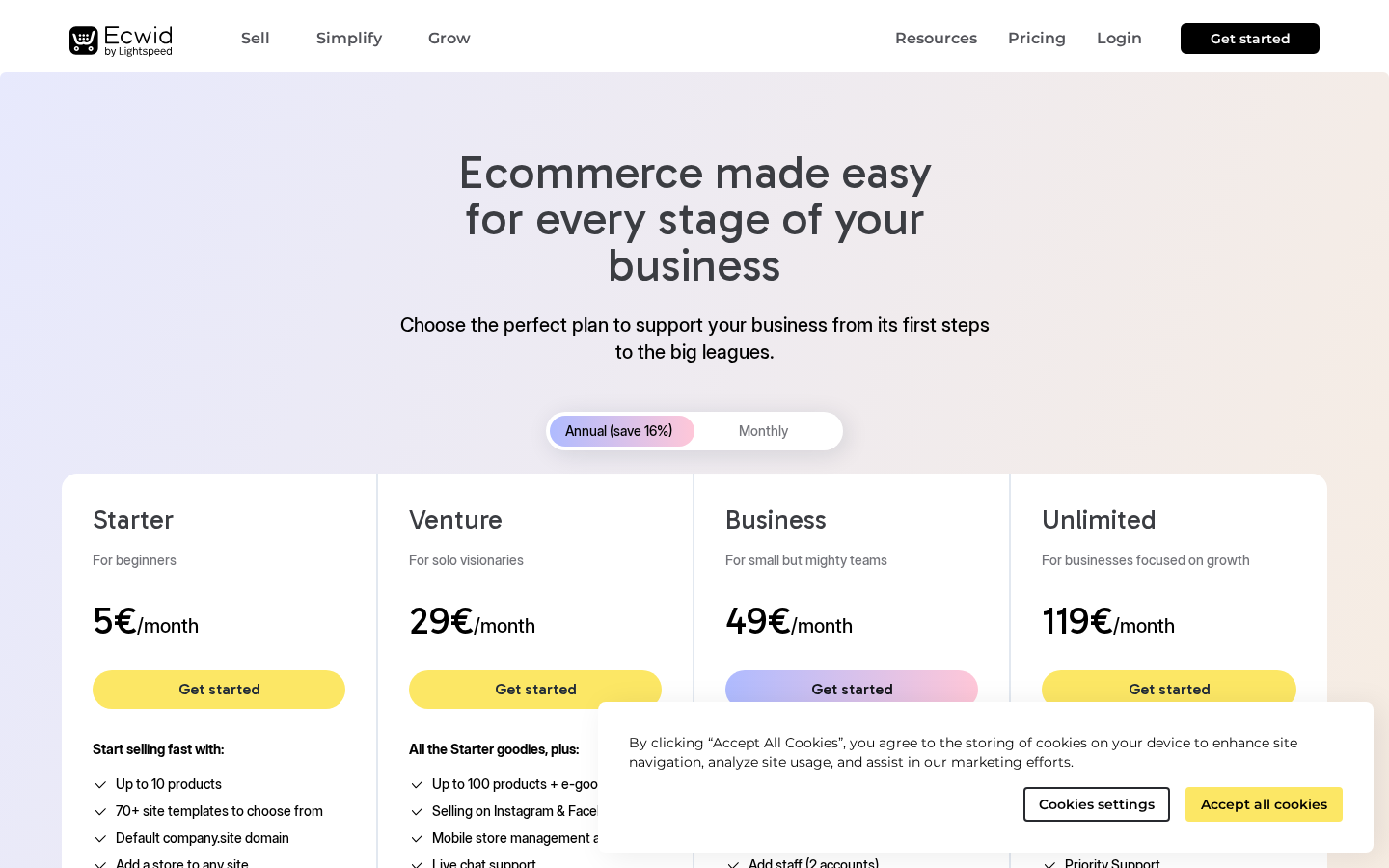
Comparison to WooCommerce total cost. At Unlimited ($119/month = $1,428/year), Ecwid’s cost is comparable to a mid-tier WooCommerce setup with managed hosting, subscriptions extension, and a couple of premium plugins. For stores under 100 products, Venture at $29/month ($348/year) is cheaper than WooCommerce with managed hosting. For stores with complex extension requirements, Ecwid’s per-plan pricing can be competitive. The comparison shifts as catalog size grows: at 1,000-plus products requiring the Unlimited plan, a self-hosted WooCommerce setup typically costs less.
Pros and cons
Pros
- Fast, low-friction setup. A working store with payments and shipping can be live in under an hour.
- No transaction fees at the platform level on any plan.
- PCI DSS Level 1 compliance managed at the platform level, without hosting-side configuration.
- Multi-channel selling built in from Venture: Facebook, Instagram, TikTok, Pinterest, Snapchat, Amazon, eBay, and Google Shopping in one dashboard.
- Real-time shipping carrier rates (USPS, UPS, FedEx, DHL, Canada Post, Australia Post) included without a separate extension.
- Zero maintenance. Security patches, platform updates, and backups are Ecwid’s responsibility.
- One store embeds across multiple websites simultaneously from one account.
- 70-plus payment gateway integrations across global and regional markets.
- 10 Gutenberg blocks for flexible WordPress page integration beyond a single Shop page.
- SEO-friendly URLs introduced in version 7.0.
- Serves 175 countries, 45 languages.
- No long-term contract required; month-to-month billing available.
- Automated tax for US, Canada, and EU VAT included.
- Lightspeed POS integration for unified in-store and online retail (Unlimited plan).
Cons
- No permanent free plan. Starter at $5/month covers only 10 products.
- Strict product limits: 10 on Starter, 100 on Venture, 2,500 on Business. Unlimited plan required for no cap.
- Store data lives on Ecwid’s servers, not your WordPress database. Direct database access and migration flexibility are limited.
- Trustpilot rating of 2.6 out of 5 (433 reviews): recurring complaints about price increases, auto-renewal terms, and EU invoice compliance.
- SEO limitations versus WordPress-native solutions. Product pages are not native WordPress content; they render within the Ecwid embedded widget.
- EU merchants report missing support for Peppol and B2B e-invoice formats required in some jurisdictions.
- Subscriptions, abandoned cart recovery, and product reviews all require Business plan ($49/month annual) minimum.
- App Market access requires Venture plan or above; Starter merchants are locked out of third-party integrations.
- Customization depth limited compared to WooCommerce. Storefront design changes happen inside Ecwid’s interface within a more constrained set of options.
- 20,000-plus active installs is a small community compared to WooCommerce’s 7 million, meaning fewer community tutorials and theme integrations.
- Auto-renewal 90 days before annual expiry with no refund after is not standard practice and has caught users off guard.
- Phone support available only from Business plan and above.
Alternatives to Ecwid
- WooCommerce. The dominant WordPress ecommerce plugin, self-hosted, open-source, free core with paid extensions. Choose WooCommerce if you want full data control, unlimited products without a monthly platform fee, deep WordPress theme and SEO integration, and maximum customization depth. Requires more setup and ongoing maintenance.
- BigCommerce for WordPress. Another SaaS storefront that embeds in WordPress, targeting larger merchants with higher product volumes and native B2B features. Choose BigCommerce for WordPress if you are outgrowing Ecwid’s product limits and want a comparable SaaS model with more catalog headroom.
- SureCart. A newer WordPress ecommerce plugin with a hosted order-processing layer and simpler pricing structure. Choose SureCart if you want a lighter approach to digital products, subscriptions, and simple physical product sales.
- Easy Digital Downloads. Purpose-built for digital products: software, PDFs, audio, video. Choose EDD if your catalog is entirely digital and you want a WordPress-native solution focused on file delivery.
- Shopify. A fully hosted ecommerce platform, not a WordPress plugin. Choose Shopify if you are willing to move entirely off WordPress for a managed, all-in-one store. Monthly plans from $39 to $399, plus a platform transaction fee without Shopify Payments.
The practical choice for most WordPress site owners evaluating Ecwid is between Ecwid and WooCommerce. Ecwid wins on setup speed, managed infrastructure, and multi-channel sync out of the box. WooCommerce wins on data control, SEO depth, customization, and long-term cost at scale.
Final verdict
Ecwid is a competent, well-maintained SaaS ecommerce platform that embeds cleanly into WordPress. If you want the fastest path from a WordPress site to a live store with payments, shipping, and multi-channel sync configured, Ecwid delivers that. The zero-maintenance model is a genuine advantage for non-technical store owners who want no part of plugin conflicts, PCI compliance configuration, or security patches.
The honest version of that story includes the product limit structure, the pricing history, and the SEO trade-offs. Ten products for $5 per month is a real restriction. Reaching any meaningful catalog size requires Business at $49/month annual, and Trustpilot’s 2.6-star average reflects real merchant frustration with price increases and billing terms. Ecwid’s SEO improvements in version 7.0 are genuine progress, but product pages embedded in a SaaS widget remain a different proposition from native WordPress content for organic search.
For small businesses adding a curated product line to an established WordPress site, Ecwid is a strong, practical choice. For stores where catalog depth, SEO-driven organic traffic, or full data control matter to long-term success, WooCommerce or another self-hosted option is more likely to serve that future.
FAQ
Is there a free version of Ecwid?
No. Ecwid does not offer a permanent free plan. A free trial is available when you create an account, letting you test the dashboard and product management before selecting a paid plan. The lowest paid tier, Starter, costs $5 per month and includes up to 10 products.
How many products can I sell with Ecwid?
The number of product listings depends on your plan. Starter allows 10 products. Venture allows 100 products. Business allows 2,500 products. The Unlimited plan removes the cap. Digital products are available from the Venture plan onward.
Does Ecwid charge transaction fees?
No. Ecwid does not charge a transaction fee at the platform level on any plan. You pay only the fees your chosen payment gateway charges.
Does Ecwid work with WordPress Gutenberg?
Yes. Ecwid includes 10 Gutenberg blocks for WordPress: a full storefront block, product browser, product search bar, category menu, cart button, and single-product display blocks. You can combine these with standard WordPress content blocks to build integrated-looking product pages.
How does Ecwid compare to WooCommerce?
The core difference is architecture. WooCommerce installs a complete ecommerce engine into your WordPress database: your products, orders, and customers live on your own hosting. Ecwid is SaaS: your store data lives on Ecwid’s servers and the WordPress plugin is a display layer. Ecwid is faster to set up and requires no ongoing maintenance. WooCommerce gives full data control, deeper WordPress SEO integration, unlimited products without a platform fee, and more customization depth at the cost of more setup complexity and maintenance responsibility.
Is Ecwid good for SEO?
Ecwid has improved its SEO capabilities, most notably with version 7.0 which introduced clean SEO-friendly URL structures for products and categories. Product pages include custom meta titles, meta descriptions, Open Graph tags, and schema.org product markup. The limitation compared to WooCommerce is that Ecwid product pages render within the SaaS widget rather than as native WordPress content. Deep integration with WordPress SEO plugins like Yoast SEO at the product level is not available.
Can I use Ecwid on multiple websites?
Yes. One Ecwid account can embed the same store on multiple websites: a WordPress site, a separate HTML page, a Facebook page, and other platforms at the same time. Products, inventory, and orders are managed in one place and reflected everywhere the store is embedded.
What payment gateways does Ecwid support?
Ecwid integrates with more than 70 payment gateways, including Lightspeed Payments, PayPal, Stripe, Square, Klarna, Apple Pay, and Google Pay, plus many regional options across Europe, Asia-Pacific, and Latin America.
Does Ecwid support subscriptions?
Yes, but only from the Business plan ($49/month annual) and above. The Venture plan does not include subscriptions. If recurring billing is a core requirement, budget for at least the Business tier from the start.
What are the main complaints about Ecwid?
The most common complaints in user reviews include: annual price increases (Trustpilot reviewers report significant year-over-year jumps), strict product limits that force plan upgrades sooner than expected, auto-renewal terms that apply 90 days before the annual plan’s expiry date with no refund after, and EU invoice compliance gaps. On WordPress.org (4.5/5 from 228 reviews), the most common friction point is feature gating: digital product support, coupon codes, and App Market access all require upgrading from the Starter plan.